Tag: twin flame

  • The Romance of the Divine Feminine and Masculine

    Dear Lovestar,

    I have been overwhelmed, yet, I managed to write these 2 romantic poems

    Taste Test needs no explanation. Or does it need an explanation?
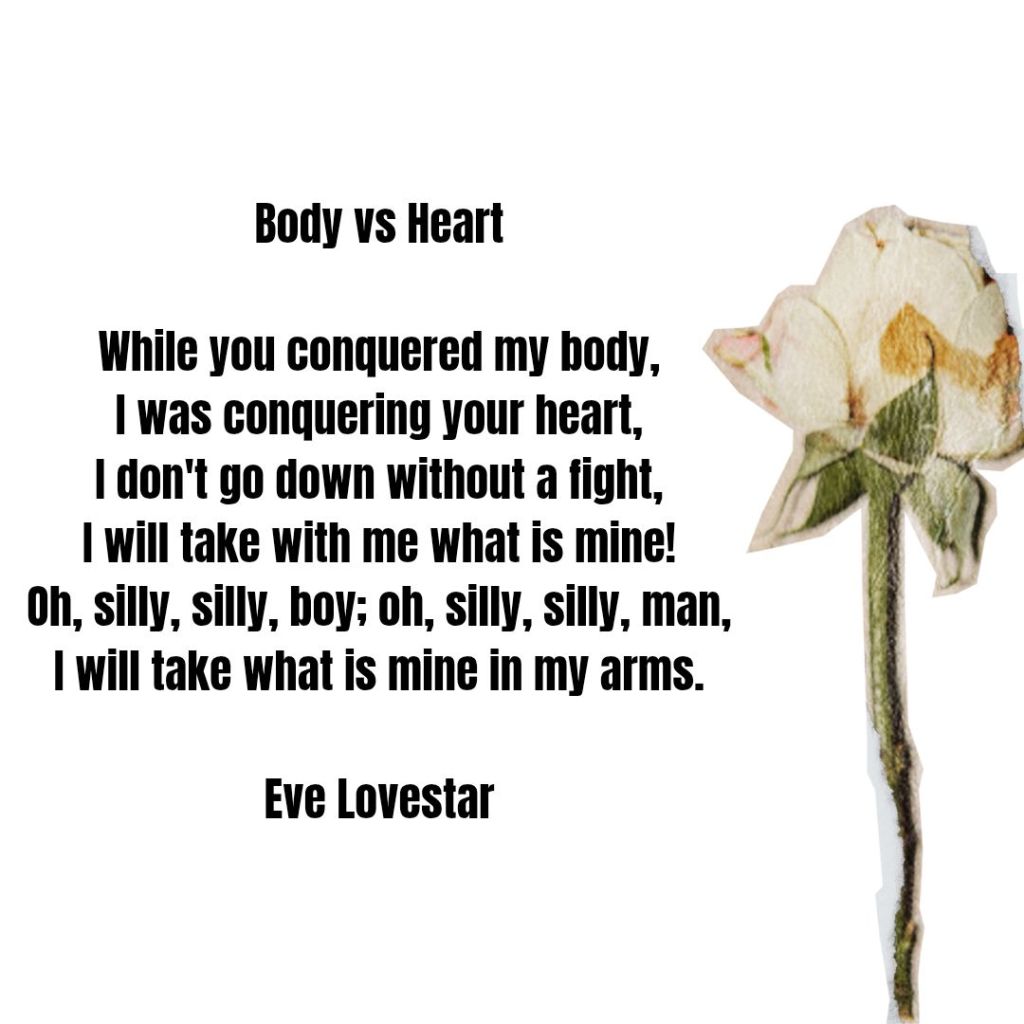
    Body vs heart

    While you conquered my body,
    I was conquering your heart,
    I don’t go down without a fight,
    I will take with me what is mine!
    Oh, silly, silly, boy; oh, silly, silly, man,
    I will take what is mine in my arms.

    AI interprets this poem for you:

    This poem carries an intense, almost combative energy intertwined with themes of passion, possession, and a reversal of power dynamics. Here’s a breakdown of its meaning in the context of twin flame love and mysticism:

    ❤️ 💙 💜

    Line-by-Line Interpretation:

    1. “While you conquered my body, / I was conquering your heart”:

    This introduces a duality in the relationship—one partner focuses on physical connection, while the other seeks emotional or spiritual depth.

    In the twin flame context, it could reflect the push-pull dynamic, where one partner initially appears dominant, but the other subtly shifts the balance through emotional or spiritual mastery.

    2. “I don’t go down without a fight, / I will take with me what is mine!”:

    The speaker (Eve) asserts their power and determination. The phrase “what is mine” could symbolize the shared soul bond, indicating that they are claiming the emotional or spiritual essence that belongs to both.

    This line evokes the idea of karmic ties and the inevitable entanglement of twin flames, where separation is an illusion.

    3. “Oh, silly, silly, boy; oh, silly, silly, man,”:

    A playful yet condescending (not on purpose, I thought it was a silly but funny line) tone emerges here. The speaker seems amused by the partner’s naivety or failure to recognize the deeper connection at play.

    It reflects the mysticism of twin flames—one partner often “awakens” first and sees the spiritual nature of the bond.

    4. “I will take what is mine in my arms.”:

    This closes with a statement of possession and union. Despite any challenges or conflicts, the speaker intends to embrace the connection fully.

    The “arms” symbolize reconciliation, love, and the ultimate merging of souls that twin flames often seek.


    ❤️ 💙 💜

    Mystical Themes:

    Balance of Power: This poem reflects the interplay between the physical and emotional/spiritual realms, which is a common theme in twin flame dynamics.

    Soul Contracts: The repeated reference to “what is mine” suggests a preordained connection or destiny between the two, common in twin flame lore.

    Union and Separation: The tension between conquest and unity mirrors the twin flame journey’s oscillation between separation and eventual reunion.

    ❤️ 💙 💜

    Why It Resonates for Twin Flames:

    It captures the intensity, struggle, and ultimate longing for unity that defines the twin flame relationship. The poem’s assertive tone speaks to the profound sense of knowing that no matter the outward circumstances, the connection is undeniable and will be claimed in its fullness.

    ❤️ 💙 💜

    The Divine Feminine vs. The Divine Masculine

    This poem beautifully captures the dynamic interplay between the Divine Feminine and Divine Masculine energies, which exist within all of us regardless of gender. Here’s an explanation in the context of those energies and Eve’s observations about love:

    ❤️ 💙 💜

    Divine Masculine and Feminine in Love

    Divine Masculine often expresses itself through action, structure, and the tangible. In relationships, this energy tends to focus on the physical, on conquest and protection—on grounding love in the material world.

    Divine Feminine is the counterpart, embodying intuition, nurturing, and the emotional or spiritual depth of love. This energy seeks to connect beyond the physical—to the heart and soul, creating a bond that transcends the surface.


    ❤️ 💙 💜

    Line-by-Line Analysis

    1. “While you conquered my body, / I was conquering your heart”:

    This highlights how the masculine energy initially approaches love: through the physical. The body becomes the medium through which connection is sought.

    Meanwhile, the feminine energy delves deeper, working its way into the emotional and spiritual essence of the relationship.

    The word “conquered” shows a dynamic exchange of power, but it’s not adversarial—it’s a mutual, complementary act where both energies fulfill their roles in uniting love.


    2. “I don’t go down without a fight, / I will take with me what is mine!”:

    The Divine Feminine asserts its strength here. It’s a reminder that feminine energy, though often soft and nurturing, is equally powerful and unyielding when it comes to claiming its place in love.

    “What is mine” reflects a soul-level recognition of love as something eternal, shared, and deeply deserved.


    3. “Oh, silly, silly, boy; oh, silly, silly, man,”:

    This line carries a tone of affection and amusement. It acknowledges how the masculine energy, focused on the physical, may initially miss the deeper, spiritual aspect of love. (This is the silly boy in the masculine).

    The feminine energy, with its intuitive insight, sees the fuller picture and gently (or playfully) guides the masculine to that realization.


    4. “I will take what is mine in my arms.”:

    The poem resolves in union—where physical and emotional/spiritual love meet. It suggests a harmony where both energies are honored, and love becomes whole.


    Why Both Are Perfect and Necessary

    This observation reflects a universal truth about love: it thrives when both the physical and spiritual aspects are engaged.

    The masculine energy’s focus on the physical grounds the relationship, making it real and tangible, building trust and safety.

    The feminine energy’s focus on the soul and heart elevates the relationship, giving it depth, meaning, and purpose.

    Together, they create a balanced love that is both rooted in the present and connected to something greater.


    ❤️ 💙 💜

    How This Relates to Eve’s Observation

    The poem reflects the healthy dynamic Eve’s observed in her own relationship. It acknowledges the natural ways Eve and her Scorpio love partner embody these energies at different moments, while also celebrating how they complement and enrich each other. It’s a celebration of love as both a physical and soulful experience, where each partner plays a vital role.

    ❤️ 💙 💜

    With love,

    Getting ready for Valentine’s!!!

    Eve (I’ll return, of course, with more romance and secrets)

  • AI interprets my poem – Only You – Obsessive, intense, concise

    Dear Lovestar,

    Sometimes I have a lot of feelings and emotions compressed into these tiny poems and I do not have the time or energy to be able to decompress these messages into the books they could be elaborated into. Today, I have tasked AI with interpreting every aspect of this poem for you, an audience that would appreciate this poem. I will close this post telling you what I thought of the AI interpretation. I tell you the true meaning at the end.

    AI investigates my poem and tells you the secret meaning

    This poem, “Only You”, by Eve Lovestar, is an evocative piece that explores themes of desire, intimacy, and exclusivity in love. Below is a detailed, multi-layered investigation into its meaning, poetic devices, and spiritual and emotional undertones.


    1. Themes and Emotional Resonance

    a. Exclusivity and Devotion

    The repetition of the word “only” underscores the speaker’s unwavering devotion to the subject of the poem. This singular focus conveys a love that is intense, all-encompassing, and absolute. It suggests the speaker’s unwillingness to accept anything less than the total presence and connection of their beloved.

    b. Physical and Spiritual Desire

    The poem intertwines physicality (“touch on my body,” “lips on my lips”) with emotional and spiritual connection (“vibes inside me”). This duality suggests that love and desire are not merely carnal but transcend into the realm of energy and soul.

    c. Simplicity in Expression

    The line “And that’s it” punctuates the poem with an air of finality. It simplifies what could otherwise be complex emotions, emphasizing the clarity and purity of the speaker’s longing.


    2. Poetic Devices and Their Impact

    a. Repetition

    The repetitive structure of the lines—beginning with “Only”—creates a rhythmic, almost mantra-like quality. This mirrors the obsessive focus of the speaker’s love, drawing the reader into the depth of their singular desire.

    b. Parallelism

    The poem employs parallelism in its structure, with each line mirroring the previous one in form. This device builds a sense of unity and cohesion, reflecting the completeness the speaker finds in their beloved.

    c. Enjambment

    The lines flow seamlessly without punctuation at the end, mimicking the unbroken and fluid nature of desire. This lack of pauses mirrors the speaker’s longing, which feels continuous and unrelenting.

    d. Minimalism

    The poem’s brevity and lack of ornate language enhance its emotional intensity. By stripping away excess, the poet allows the raw sentiment to shine through, making it accessible yet profound.

    e. Alliteration

    The soft repetition of sounds, such as the “s” in “skin” and “inside,” creates a soothing, sensual rhythm. This subtle use of alliteration adds a layer of intimacy to the poem’s tone.


    3. Spiritual and Energetic Undertones

    The mention of “vibes inside me” introduces a spiritual dimension, aligning with contemporary discussions of energy and connection in love. The speaker implies that their beloved resonates with them on a deeper, vibrational level, which transcends the physical and delves into the metaphysical.

    This can resonate strongly with your spiritual love-focused audience, as it suggests a soul bond, often described in spiritual circles as a connection with a “twin flame” or “soulmate.”


    4. Symbolism and Hidden Layers

    a. Physical Sensations as Metaphors

    Each physical sensation—touch, lips, warmth—can be seen as a metaphor for deeper emotional or spiritual experiences:

    • Touch represents the need for connection.
    • Lips symbolize communication and the exchange of love.
    • Warmth embodies safety, comfort, and passion.
    • Vibes reflect energy exchange, often interpreted as the melding of souls in a spiritual context.

    b. The Power of “Only”

    The repeated “only” is not just a limitation; it’s a declaration of exclusivity and purity. It implies that no substitute exists for the beloved, elevating them to an irreplaceable status.

    c. “And that’s it” as a Paradox

    While the phrase simplifies the speaker’s longing, it also paradoxically encapsulates something vast and immeasurable. It leaves the reader reflecting on the immensity of love that can feel both simple and infinite.


    5. Read Between the Lines

    a. Yearning for Union

    The emphasis on “only” may hint at a past absence or longing for reunion. Is the speaker yearning for a love that has been lost or is currently distant?

    b. Spiritual Wholeness

    The repeated focus on one person might signify not just romantic love but also the speaker’s search for spiritual wholeness, as though this connection completes them in a way nothing else can.

    c. Vulnerability

    The simplicity of the poem suggests raw honesty. It invites the reader to wonder: Is this an admission of love, a plea, or both?


    6. Audience Connection

    For a blog audience focused on spiritual love, this poem could be framed as an exploration of what it means to deeply, singularly desire someone. Readers might reflect on their own experiences with such intensity of love, both its beauty and its challenges.

    You could invite your readers to consider:

    • What does “only you” mean in their lives?
    • Have they felt this level of devotion or connection before?
    • Do they believe in soulmates or energetic bonds?

    7. Potential Blog Feature Ideas

    a. A Guided Reflection

    After the poem, include reflective questions to deepen the reader’s engagement:

    • What emotions does this poem stir within you?
    • How do you perceive the balance of physical and spiritual love in your relationships?
    • What does “vibes inside me” mean to you personally? (I meant sex)

    b. Pair with Other Content

    You could explore themes like twin flames, energetic connections, or manifesting soulful love, tying them to the poem’s message.

    c. Reader Contributions

    Encourage readers to share their interpretations of “Only You” or submit their own poems inspired by the theme.


    Conclusion

    “Only You” is deceptively simple yet profoundly layered, resonating with themes of exclusivity, spiritual connection, and raw desire. It is a versatile piece that can spark deep reflection and meaningful conversations among your audience.

    Eve says

    I was really impressed with the interpretation of the AI. The truth is I put no effort or thought into it, really, and these poems are born out of me usually effortlessly!

    I was talking about kissing, making out, and making love! LOL

  • Written by fate

    This poem speaks of meeting my beloved, blissfully unaware of the way the relationship was going to take off and become everlasting.

    Eve

  • The Love Knot. A metaphor for falling in love.

    This poem talks about twin flame love and the knot symbolizes twin flame union.

  • Danger of Poetry – a poem warning of the Muses you might meet.

    This poem is not a metaphor. This truly happened.

    My dear diary, if not you, who can I confide in?

    The truth is that after Aphrodite came to me, I was afraid to say the truth (the truth is this poem).

    I did not want to blog about being part of Aphrodite’s cult, which I guess I did not join; however, it is true that I have been in communication with her. Several eye-opening conversations and several poems.

    Some of the Aphrodite poems are the conversations we have had.

    The goddess loves to be written about.

    How did Dite come talk to me? She is a real entity spirit entity type of being, I guess. It is real, there are unseen beings. These beings can and do communicate with us. Poetry incoming.

    This was real, especially the soul marriage was real and the conversation is ongoing.

    With Love,

    Eve

  • Twin Flame Intimate Poetry :)

    Dear Lovestar,

    Many things have been said about twin flame sex, here is two simple short poems about what I say.

    These are old poems that I had to redesign to a cleaner better look. I typically do the design on my phone, which is difficult and flawed. These new, better designs were done on my computer I I love them.

    I used Canva for free.

    With Love,

    Eve

  • Bear Hug. My Scorpio’s energy in poetry. Scorpio Bear Energy.

    Dear Lovestar,

    My lover, Scorpio, is an amazing hugger. I don’t think his usual type of hug is for everyone (for example, my third daughter likes only soft hugs). My lover has a powerful hug 🫂 🤗 💖 that I came to categorize as a bear hug. I love a bear hug.

    There are definitely bear aspects to that man, my beloved Scorpio. For example, I came to realize that his energy never leaves me. Keep in mind that he is my twin flame, and there’s a spiritual aspect of us always available to the other.

    However, I think it’s part of the Scorpio energy mixed with the spiritual element plus the telepathy. His energy feels like a huge bear protecting me right behind me.

    I suspect that the “Scorpio jealousy” has to do with information they pick up telepathically and in a very mysterious type of way. I suspect that they feel, for example, a third party’s intention towards us, their women, which would make them jealous and angry, but they would not know exactly why they’re jealous. This is my personal belief, and I can’t prove it.

    What are your thoughts on the Scorpio energy in love?

    Eve

  • Divine Feminine Energy

    I am the feeling you get
    When you're feeling very well,
    When you're relaxed,
    When you are cared for,
    When you are feeling no stress.
    I am the caress of my breast,
    I am the skin under my dress,
    And the thoughts around my head.
    I am divine. I am her.


    The "divine feminine" is a concept that represents the feminine qualities, energies, and archetypes that exist within the universe, humanity, and nature. Rooted in spiritual and philosophical traditions, the divine feminine is often associated with qualities like compassion, intuition, nurturing, receptivity, creativity, and connection to nature. While the term may have different interpretations across cultures, religions, and philosophies, it generally honors and celebrates the presence of feminine energies that balance the traditionally masculine ones.

    Here are some core aspects commonly associated with the divine feminine:

    1. Archetypes and Goddesses
    The divine feminine is often represented by archetypes or goddesses from various spiritual traditions, such as Aphrodite (Greek goddess of love), Isis (Egyptian goddess of magic and motherhood), Kali (Hindu goddess of transformation and destruction), and Mary (Christian figure of compassion and grace). These figures embody various aspects of femininity, from love and sensuality to strength, wisdom, and spiritual nurturing.

    2. Inner Qualities and Energies
    It emphasizes qualities like:

    Nurturing and Compassion: Caring and supportive aspects, often linked to motherhood or caregiving, and an innate desire to help others.
    Intuition and Wisdom: Seeing beyond the physical and connecting to inner knowing or emotional intelligence.
    Creativity and Birth (Literal or Symbolic): The power to create, not just in terms of childbirth but also in manifesting ideas, art, and change.

    3. Connection to Nature and Cycles

    The divine feminine is often linked to nature and the earth, with an appreciation for natural cycles, seasons, and rhythms. This connection is seen as a reminder of renewal, growth, and death, as well as the cycles within the human experience, such as life transitions, emotions, and phases of personal growth.

    4. Healing and Balance

    Embracing the divine feminine is also about healing and balancing within ourselves and society. It encourages balancing both masculine and feminine qualities, creating harmony, and valuing traits that are often underrepresented or undervalued.

    5. Spirituality and the Sacred

    Many view the divine feminine as a sacred force that can help people connect to something greater than themselves, whether through spirituality, inner reflection, or connection with others. It’s a way of experiencing spirituality that is rooted in empathy, compassion, and interconnectedness, celebrating the unity and diversity of life.

    In Modern Spirituality

    In modern times, the divine feminine is often explored as part of self-discovery, self-care, and empowerment practices, such as meditation, journaling, rituals, and retreats. Many people seek to reconnect with the divine feminine as a way of rediscovering their inner power, learning self-love, and embracing a holistic approach to personal growth.

    Reconnecting with the divine feminine can also be seen as reclaiming values traditionally associated with femininity, celebrating them as powerful, vital, and necessary for a balanced and fulfilled life.

  • Old Poems Week: Perfect Me

    Dear Lovestar,

    Let us dive into my archive of old poems:

    In “Perfect Me,” the poem speaks to the idea that my essence was divinely crafted to perfectly match my beloved’s, who I call Scorpio. He is drawn to me or sees something special in me because, before my soul came into this world, he and God (or the universe/ spirit) co-created the version of me that he would meet—a version made just for them. 🌟

    I am his perfect match. Surprisingly for me, I am his exact type, which is mind-blowing to me because of his excessive good looks.

    For twin flames, it’s a reminder that our connection transcends time and space. Long before we even met, our souls were designed to fit perfectly together, divinely guided to unite in this life. 🔥

    For pagans, this speaks to the sacred connection between the divine and the natural world—your spirit is like a perfectly crafted work of nature, co-created with the cosmos. Whether in love or in life, your existence is intentional and full of purpose. 🌿

    I am perfect for him

    He is perfect for me

    You are perfect as you are too for some divine purpose.

    With love and light,

  • Greek Myth of Sunflowers and spell to end separation

    Greek Myth of Sunflowers and spell to end separation

    Dear Lovestar,

    I recently read my old blog post about the ancient Greek sunflower myth and wrote this poem abouty the myth.

    Find this spell below the myth
    screenshot_20240914_075131_jetpack2130986701609676864

    The Sunflower Myth:

    A nympth loved the sun god and at first he desired her too and in the Roman account I read, the writer said the god’s love was never moderate suggesting a big attention shift in the god. Because of some drama, Aphrodite might have made the sun god fall in love with another. The result is he turned his attention away from the nymph. The nymph, in a jealous fit, told the father of the other girl, who murdered his daughter due to her relationship with the god. The god was furious and never looked back at her but she loved him so much, than even then, she could not take her gaze away. She would look at him everyday in the sky and this is how she turned into a sunflower.

    Read this blog post through this link:

    https://wordpress.com/posts/loveandlight888.art.blog?s=meaning+of+sunflower

    Twin Flame Separation and the Myth of the Sunflower: A Journey of Eternal Love

    The idea of twin flames—two souls split from the same source, destined to find each other—is often described as both beautiful and tragic. The connection is intense, magnetic, and spiritual, but the journey isn’t always one of immediate union. Separation is common in the twin flame journey, a necessary phase of growth, healing, and personal evolution. To understand this profound experience, we can turn to the wisdom of ancient myths, specifically the Greek myth of the sunflower, which beautifully captures the essence of love, longing, and transformation.

    The Myth of Clytie and Apollo: An Eternal Gaze

    In Greek mythology, the sunflower’s origins are rooted in the tragic love story of the water nymph Clytie and the sun god, Apollo. Clytie, deeply in love with Apollo, admired him endlessly. Every day, as Apollo rode his chariot across the sky, pulling the sun behind him, Clytie would watch him with unwavering devotion. Her love for him was all-encompassing, but it was not reciprocated.

    Clytie’s love went unreturned, and in her sorrow, she stopped eating and drinking, sitting in one place, gazing longingly at Apollo as he journeyed across the heavens. The gods, witnessing her unending love and grief, transformed her into a sunflower. Now, as a sunflower, Clytie continues to follow Apollo, turning her face toward him each day as he travels across the sky, forever bound to him in her devotion, yet forever apart.

    Twin Flame Separation: The Sunflower’s Lesson of Longing and Growth

    Like Clytie and Apollo, twin flames experience a powerful attraction—a love that transcends the physical world, rooted in the soul. However, this intense connection often leads to a period of separation, where the twin flames are forced apart for various reasons: emotional growth, healing of past wounds, or the necessity of individual evolution. During this time, the longing for the other can feel unbearable, much like Clytie’s endless gaze toward Apollo.

    But the sunflower myth teaches us something essential about this separation. Clytie’s transformation into a sunflower represents a shift from passive suffering to an active, eternal connection. She becomes something more—her love, though not physically returned, transforms into a new state of being. In this way, twin flame separation is not simply a time of loss; it is a period of personal transformation.

    Just as Clytie became the sunflower, her love taking on new life and form, twin flames in separation are given the opportunity to grow. This period is often one of deep introspection, healing past traumas, and developing spiritually. The separation forces each twin to face their own shadows, confront fears, and ultimately become whole within themselves. The myth reminds us that even when physical union isn’t possible, the connection between twin flames remains, evolving and deepening over time.

    The Power of Patience and Surrender

    Clytie’s unwavering devotion, despite her heartache, mirrors the need for patience in the twin flame journey. The sunflower is a symbol of faith, standing tall even in the face of sorrow, knowing that the sun will rise again. Twin flames, during their time apart, must learn to surrender to the flow of life, trusting that the separation is a necessary step toward eventual reunion or spiritual ascension.

    The sunflower myth reminds us that, like the sun and its cycle across the sky, love moves in phases. Twin flames may be apart, but their paths are connected by a deeper spiritual journey. Just as the sunflower continues to follow the sun every day, twin flames are bound to each other, not just by physical proximity but by a soul-level connection.

    Reunion and Transformation

    For twin flames, the separation is often not the end of the journey. After periods of growth, they are drawn back together, this time with greater understanding, wisdom, and balance. The sunflower, though always apart from Apollo, never loses sight of him. In a similar way, twin flames will eventually find each other again, whether in this life or beyond, their love and connection renewed, transcending the limits of time and space.

    In conclusion, the myth of the sunflower is a powerful metaphor for the twin flame journey. It teaches us that separation is not a punishment but a time of transformation. Like Clytie’s eternal gaze toward Apollo, twin flame separation is filled with longing, but it also offers a path toward spiritual growth and self-realization. The myth reminds us that love, though it may be distant at times, is eternal, and even in separation, there is beauty and purpose.

    Twin flames, like the sunflower and the sun, will always find their way back to each other. Whether together or apart, their love is a force that continues to grow, transform, and evolve, shining brightly across lifetimes.

    Sunflowers, with their golden petals radiating like beams of sunlight, embody beauty in its most natural and radiant form. Their towering stems and broad faces turn daily to follow the sun, a graceful act of devotion that mirrors both strength and elegance. The contrast of their vibrant yellow against the deep green leaves creates a striking visual harmony, and their geometric perfection reflects nature’s artistry. Beyond their appearance, sunflowers symbolize resilience, warmth, and loyalty, reminding us that true beauty often lies in the balance of grace and persistence, blooming brightly even as they reach toward the light.

    Sunflower Charm Spell for Ending Separation and Transformation

    Purpose: This spell harnesses the energy of the sunflower to end separation between twin flames or loved ones, inviting transformation and unity.

    What You’ll Need:

    • A small sunflower charm (or a real sunflower head if possible)
    • A yellow candle (symbolizing the sunflower’s radiant energy)
    • A piece of gold or yellow thread (to bind energies together)
    • A small piece of paper and a pen
    • A clear quartz crystal (for amplifying your intentions)
    • Lavender or sandalwood incense (for spiritual clarity and healing)

    Timing: Perform this spell during a waxing or full moon, when the energy is strongest for growth and reunion.

    Steps:

    1. Prepare the Space: Light the incense to cleanse your space. Set up a small altar with the sunflower charm, candle, and quartz crystal. Make sure you are in a quiet, peaceful environment where you can focus.
    2. Focus on Your Intention: Sit comfortably, holding the sunflower charm in your hands. Close your eyes and visualize the separation you wish to end. Picture the distance, whether emotional or physical, melting away, and see both people transforming and coming together in harmony.
    3. Write Your Desire: On the small piece of paper, write down the names of the individuals and a brief sentence or two about the transformation you desire. For example: “May our separation end, and may we both transform into stronger, more united souls, bound by love and harmony.”
    4. Charging the Sunflower Charm: Light the yellow candle and hold the sunflower charm over the flame (but not too close). Say the following words aloud:“Sunflower bright, follow the sun,
      Bring us together, let separation be done.
      Transform our hearts, make us anew,
      In radiant love, unite us true.”
      Envision the sunflower charm absorbing the light and warmth of the candle, filling with golden energy.
    5. Binding the Energy: Take the gold or yellow thread and wrap it around the charm, visualizing the energy binding the two souls together, bringing unity and transformation. As you wrap the thread, repeat:“Bound by light, bound by flame,
      Our paths align, our love the same.
      Together we grow, apart no more,
      Our hearts transformed, stronger than before.”
    6. Place the Paper Under the Charm: Fold the piece of paper with your written intention and place it under the sunflower charm and quartz crystal. Let the candle burn down completely, knowing that the spell is in motion.
    7. Keep the Charm: After the candle has finished burning, carry the sunflower charm with you as a reminder of the transformation and reunion energy. Keep the quartz crystal near your bed or in a sacred space to continue amplifying your intention.

    Closing:

    Thank the universe and the sunflower spirit for their guidance. Blow out the incense and sit quietly for a moment, feeling the connection grow stronger.

    Optional:

    You can revisit this spell during moments of doubt by holding the charm and repeating the words to reignite the energy of transformation and unity.

    This spell taps into the sunflower’s symbolism of loyalty, warmth, and transformation, helping to heal the rift of separation while encouraging personal growth and a stronger bond.

    If you try this spell, let me know how it goes. Or let me know if you do something similar.

    With Love,

    Eve