Tag: the energy of poetry

  • My poetic influence: My three favorite poets are Latin masters of the craft

    Dear Lovestar,

    Here I am again explaining why there is magic in poetry. A secret magic only some of us can feel and most of us, including me at times, don’t really understand even though I have certainly used poetry all my life. I always loved poetry, even when I didn’t believe in love. My favorite was always love poetry, but I have received a massive influence from patriotic poetry that makes me rebellious because I cannot stand ineffective leaders, just like Marti in his poetry and his wealth of literary works. Below, I will familiarize you with my 3 favorite poets. I read these poems in Spanish, my first language, but there are many translations of Neruda poetry I find on Pinterest all the time. His poetry is so deep, it can touch the soul.

    I find it super interesting that my favorite poets are 3 men. Since I believe these guys were the best poets in history (I do have to study more poetry, but I have a super specific taste in poetry, I don’t like all poetry) I intend to become the female contemporary continuation of these guys’ energy. That is a tall intention! To continue my journey, I will return to poetry reading so as to become more inspired. I will blog about this in the future. I write from the female perspective, which is kind of rare. I think there are many more male poets or more famous male poets.

    Pablo Neruda, the biggest romantic:

    I would read Neruda poetry as a teenager, and it had a melting effect. As I listened or read a gorgeous piece (Neruda is # 1 in my humble opinion), I could feel those wonderful feelings in me and thought, how great would it be to feel this way about someone or have someone feel this way about me. I now believe that my rendezvous with romantic poetry as a youth aided in my preparation for union with my beloved Scorpio. Romantic poetry (and romantic novels) is the only romance I ever knew. You can easily realize that those inspirational moments helped me become more of a romantic dreamer.

    I dream of reciting Neruda’s poetry!

    The poetry of Pablo Neruda, the Chilean Nobel laureate, is characterized by its passionate expression, vivid imagery, and profound depth of emotion. Neruda’s work spans a wide range of themes, including love, nature, politics, and the human experience. Here are some key aspects of Neruda’s poetry:

    1. Love and Sensuality: Neruda is perhaps best known for his love poetry, which is marked by its sensuality, romanticism, and intense emotion. His poems explore the ecstasy and torment of love, celebrating the beauty of the beloved and the transformative power of passion. Neruda’s love poems often use rich, evocative imagery drawn from nature to convey the depth of his feelings.
    2. Nature and the Natural World: Neruda had a deep affinity for the natural world, and his poetry frequently celebrates the beauty and majesty of the landscape. He imbues his descriptions of nature with a sense of awe and reverence, portraying the earth as a source of inspiration, solace, and spiritual renewal.
    3. Social and Political Themes: In addition to love and nature, Neruda’s poetry also grapples with social and political issues. He was deeply committed to social justice and used his poetry as a tool for political activism, advocating for the rights of the oppressed and marginalized. Neruda’s political poems are characterized by their passionate denunciation of injustice and their call for solidarity and resistance.
    4. Surrealism and Symbolism: Neruda’s poetry often exhibits elements of surrealism and symbolism, with imagery that is both striking and enigmatic. He frequently uses metaphor and allegory to explore complex themes and ideas, inviting readers to delve beneath the surface of his words to uncover deeper meanings.
    5. Musicality and Rhythm: Neruda was a master of language and rhythm, and his poetry is renowned for its musicality and lyrical beauty. He experimented with various poetic forms and techniques, crafting verses that are both melodic and powerful. Neruda’s use of rhythm and sound adds to the emotional resonance of his poetry, drawing readers into the immersive experience of his language.

    https://en.wikipedia.org/wiki/Pablo_Neruda

    Jose Martí, the Cuban literary genius:

    I also loved the poetry of Jose Martí (Is Martí my favorite? OMG I am having a hard time choosing but it appears that he is my favorite). Martí has been my biggest literary inspiration. He was a less famous Cuban poet of the 1800s. Martí had some romance but mostly very strong patriotic poetry that spoke about morals, duty, personality and a wealth of children’s poems that the children of Spanish speaking America are familiar with. The poetry of Martí is the soul nutrition of the Cuban children. And the sole nutrition because Cuban children (I was one) suffer from malnutrition, except than we had access to amazing poetry and writings from Martí. I was a different child; I did not care about the food for my body as much as the food for my soul.

    I really have to blog about Martí, because I have actually studied him plenty, I have his most popular book, a children’s story and poetry book (“La Edad de Oro: The Golden Age”), and he was my first inspirational speaker. Martí conveyed such power in his poetry! I learned many Martí poems and there was one, “La Bailarina Espanola” (The Spanish Dancer) that I recited for years in school. There was a second Martí poem “Yugo y estrella”: (Yoke and Star) which was a very powerful poem about freedom that I recited with my brother in school for many years and I even presented these poems outside of my school. These early days also helped me learn how to recite poetry, I have done it since I can remember, something I should do more of, but I will be the first to admit, I am a bit shy because there is so much passion in me and I don’t like to share my passion freely. I do censor myself when I speak to you, can you believe there is more… secrets…

    Marti was pre-communism and not a communist at all. Marti’s soul is probably not resting with the current political arena in Cuba.

    We can attempt to capture the essence of Martí’s poetry by considering its key characteristics:

    1. Patriotism and Nationalism: Martí’s poetry often reflects his deep love for his homeland, Cuba, and his fervent dedication to its independence. The flavor of his poetry is imbued with patriotism, evoking a sense of pride, longing, and sacrifice for the Cuban nation.
    2. Spiritual and Philosophical Depth: Martí’s poetry explores existential questions, spirituality, and the human condition. The flavor of his poetry is characterized by its philosophical depth, as Martí contemplates themes of identity, freedom, justice, and the search for meaning in life.
    3. Romanticism and Idealism: Martí’s poetry is infused with a romantic and idealistic spirit, celebrating the beauty of nature, the power of love, and the pursuit of lofty ideals. The flavor of his poetry is often tinged with a sense of optimism, hope, and reverence for the wonders of the world.
    4. Simplicity and Clarity: Martí’s poetry is known for its clarity of language and simplicity of expression. The flavor of his poetry is straightforward yet profound, with verses that resonate with emotional sincerity and authenticity.
    5. Social and Political Commentary: Martí was also a passionate advocate for social justice and political reform. The flavor of his poetry reflects his commitment to the struggles of the oppressed and marginalized, as he denounces tyranny, inequality, and injustice with a fiery indignation.
    6. Humanism and Empathy: Martí’s poetry is infused with a deep sense of humanism and empathy for the suffering of others. The flavor of his poetry is compassionate and empathetic, as Martí seeks to uplift the downtrodden, give voice to the voiceless, and inspire solidarity among all people.
    7. Lessons and morals for children: Martí was huge with expressing how “good children” behave and his poetry is super inspirational in this way. He spoke of sharing one’s wealth, children being good to slaves (he lived in a time of slavery), boys protecting girls, always being honest, etc.
    8. Beautiful imagery: Martí was a genius when it comes to painting pictures with words. From his garden with the bee, his palm tree references, his nature references, his animal references, his perfect representation of the venue where the Spanish dancer is performing. Can you tell that I know his work very well?

    In summary, the flavor of José Martí’s poetry is characterized by its patriotism, spiritual depth, romantic idealism, clarity of expression, social consciousness, and humanistic empathy. His poetry is a rich tapestry of emotions, ideas, and experiences that continues to resonate with readers for its timeless relevance and universal appeal.

    https://en.wikipedia.org/wiki/Jos%C3%A9_Mart%C3%AD

    Mario Benedetti, oh, the romance…

    Mario Benedetti, the Uruguayan poet, novelist, and playwright is another poet who deeply inspired me with his romantic poetry. He had a distinctive style characterized by its accessibility, simplicity, and emotional depth. Here are some key elements of Benedetti’s poetry style and his gifts as a poet:

    1. Everyday Language: Benedetti’s poetry often employs everyday language, making it highly accessible to readers. He has a knack for expressing complex emotions and ideas in simple, straightforward terms, which resonates with a wide audience.
    2. Personal and Intimate Themes: Benedetti’s poetry frequently explores personal and intimate themes such as love, loneliness, longing, and human relationships. He delves into the inner workings of the human heart and mind with honesty and sensitivity, creating poems that feel deeply relatable and emotionally authentic.
    3. Social and Political Commentary: Like José Martí, Benedetti was also deeply engaged in social and political issues. His poetry often serves as a vehicle for social commentary, addressing topics such as injustice, oppression, and the struggles of ordinary people. He uses his poetic voice to advocate for social change and human rights.
    4. Humor and Irony: Despite dealing with weighty themes, Benedetti’s poetry is often infused with humor and irony. He has a knack for finding moments of levity and wit even in the midst of sadness or adversity, adding layers of complexity and nuance to his work.
    5. Versatility: Benedetti was a versatile poet who experimented with various forms and styles. He wrote traditional lyrical poetry, as well as prose poems and free verse. His versatility allowed him to adapt his poetic expression to different themes and moods, showcasing his range as a writer.
    6. Emotional Resonance: One of Benedetti’s greatest gifts as a poet is his ability to evoke powerful emotions in his readers. Whether expressing joy, sorrow, hope, or despair, his poetry has a profound emotional resonance that leaves a lasting impact on those who encounter it.

    https://en.wikipedia.org/wiki/Mario_Benedetti

    Have you ever been exposed to the work of these great Latin poets? Are you interested in more exposure from these masters of this craft?

    Did you enjoy this post? Too literary or serious? I must know what kind of content you enjoy and benefit from, so I can align my creation with your needs.

    I will definitely write more about the roots of my creative writing, but if my Latin roots are too foreign, I shall do so in Spanish elsewhere.

    Do you have any topics ideas or questions I can answer in a future post? Please let me know in the comments and if you want to talk to me in private, through my poetry collection

    I enjoyed this.

    Thank you for your honest feedback and your continued support,

    Eve, remembering today…

    Coming soon to this blog: More Eve poetry, always.

    The Love quiz: I will give you tools to figure out if what you are feeling is love: Meant for new love

      Enchant the Scorpio: poetry plus can a Scorpio be enchanted? I will expose my beliefs with this topic, and I will talk against love spells: Scorpio can’t be put under a spell

      I will journal about why AI could not beat me in poetry writing… yet and what makes my poetry better. I am humble like that!


    1. Poems are vehicles for energy part 2: The energy in Eve’s poetry

      Dear Lovestar,

      I am doing a new thing today!

      As promised, on this post I will do an in-depth analysis of my own poetry.

      I am doing this (I have wanted to do this for a while) to expose the different energies behind poetry. Poetry is cool to me because it is so concise and to the point. But poetry is so powerful that there are always hidden parts that could get lost if there is no interpretation and analysis.

      In my homeland (Cuba) we had a crazy saying suggesting that the smallest perfume bottle is most potent as well as the smallest poison bottle is most deadly (I don’t know where this crazy, dark last part came from, I will assume it was a Scorpio who thought of that last part) and this is how I see poetry.

      A poem is a tiny container that packs a very large energetic punch. Poets craft their art very carefully. We carefully weave our emotions, feelings, strength, our beliefs, experiences, and our energy together with a lesson we would like to teach. We can also channel some energy that is not ours and embedded it into the poems we write. This is how come a poem can literally be transformational. The poem below has a transformational quality to it because it inspires positive change…

      Fear Exists: The inspirational poetry

      The poem “fear exists” carries a strong and assertive energy, evoking themes of courage, resilience, and defiance in the face of fear. Let’s break down the energy of the poem:

      1. Assertiveness: The poem opens with a bold and assertive statement, suggesting that fear serves a purpose—to halt the actions of those who lack courage. This assertiveness sets a tone of determination and conviction, indicating that the speaker is not afraid to confront fear head-on.
      2. Empowerment: The phrase “stop the cowards” suggests a sense of empowerment and agency. Rather than being controlled or overwhelmed by fear, the speaker implies that individuals have the power to overcome it and take action despite its presence.
      3. Challenge: The poem poses a challenge to the reader, urging them to confront their own fears and push past their limitations. It suggests that fear should not be a barrier to progress or growth but rather a catalyst for bravery and self-discovery.
      4. Resilience: There is a resilience inherent in the poem’s message, as it implies that fear can be conquered through courage and determination. The energy of the poem is one of resilience in the face of adversity, encouraging the reader to persevere in the pursuit of their goals and aspirations.
      5. Motivation: Overall, the poem carries a motivational energy, inspiring the reader to confront their fears and embrace the inherent challenges of life with courage and fortitude. It encourages a proactive approach to fear, viewing it not as a hindrance but as an opportunity for personal growth and transformation.
      6. Gratitude: This is hardly the case; however, this daring poem expresses a sort of gratitude for fear itself. We grow when we experience fear and do what we have to do anyways.

      In summary, the energy of the poem “fear exists to stop the cowards” is one of assertiveness, empowerment, challenge, resilience, and motivation. It conveys a powerful message about the nature of fear and the potential for courage to overcome it, urging the reader to embrace bravery in the face of adversity.

      Perfect Me: The Union poetry

      This poem is transformational because it asserts that my imperfection and constant feeling and fearing my weaknesses are not something to worry about in love, because to my flame, I am perfect and further, I believe I am the most perfect woman for this man ands viceversa, of course.

      carries a sense of spiritual contemplation and self-reflection, exploring themes of divinity, destiny, and self-acceptance. Let’s examine the energy of the poem:

      1. Connection to God: The poem suggests a deep spiritual connection between the individual and a higher power, referred to as “God.” This connection implies a sense of predestination or divine purpose in the creation of the self.
      2. Union: This poem implies that the beloved had a hand in our creation, that is why they love us so much. We might not be perfect, but we are perfect for them.
      3. Self-Reflection: The poem prompts the reader to reflect on their own existence and identity. It invites contemplation of the idea that one’s attributes and qualities are part of a divine plan, crafted with intention before birth.
      4. Sense of divine Wonder: There’s a sense of wonder and awe conveyed in the poem’s exploration of the self and its relationship to a divine creator. The idea that one’s existence was designed by God suggests a profound sense of reverence and gratitude for the intricacies of life.
      5. Self-Acceptance and Self-Love: The poem implies a message of self-acceptance and self-love. By suggesting that the self was designed to be perfect by God, it encourages the reader to embrace their unique qualities and inherent worth.
      6. Spiritual Empowerment: There’s an empowering energy in the poem’s message that suggests the individual is a deliberate creation, imbued with purpose and significance. This empowerment encourages the reader to recognize their own agency and potential for greatness.
      7. Fate: This piece clearly states that I was made to order for my beloved, implying that fate was involved in our meeting. This is 100 percent how I feel about my connection. It is true that I am perfect for this man. I am not even sure how he could relate to other women, honestly because his needs are very specific, however, mysteriously, I can meet his needs!

      Overall, the energy of the poem is one of spiritual reflection, wonder, acceptance, and empowerment. It invites the reader to contemplate their connection to a divine creator and to embrace their own inherent worth and potential.

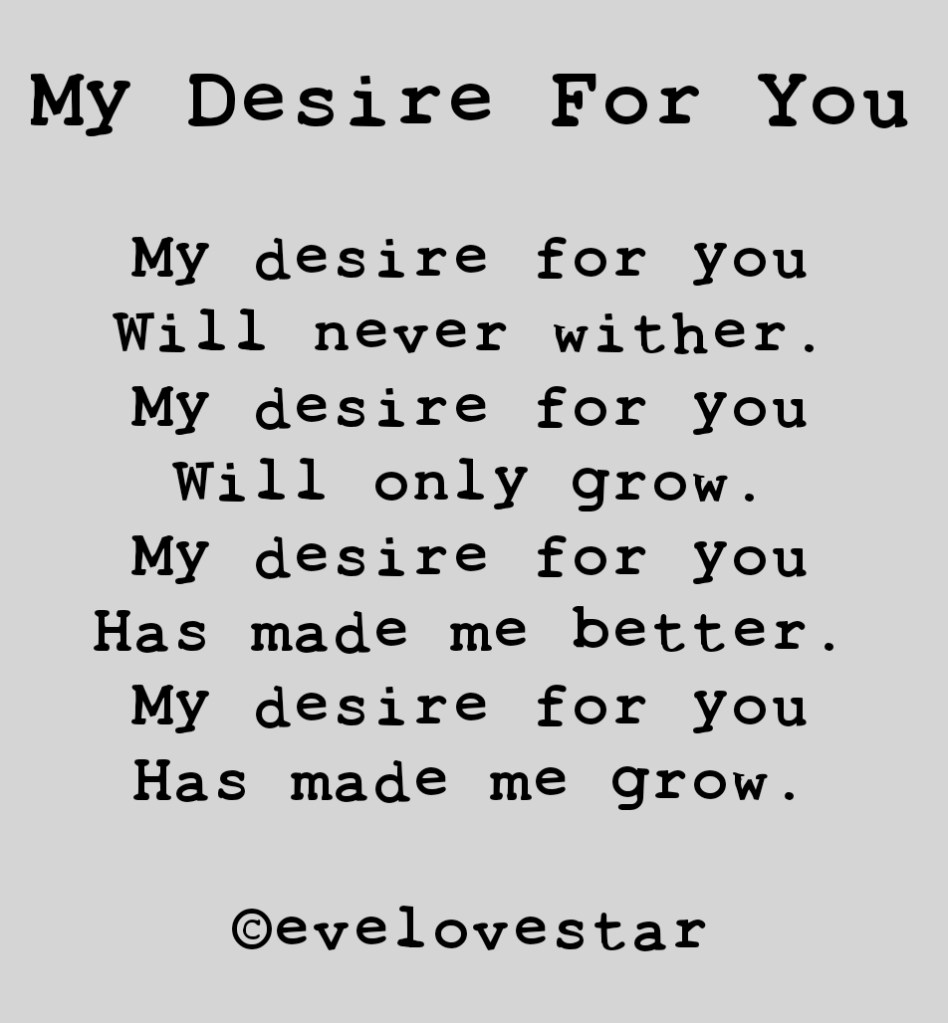
      My Desire For You: The Love Poetry

      The energy of this poem is one of passion, longing, and growth. Let’s explore its energy in more detail:

      1. Passion and Longing: The repetition of the phrase “My desire for you” emphasizes the intensity of my passion and longing. There’s a fervent energy in the repetition, suggesting that my desire is unwavering and deeply felt.
      2. Perpetual Growth: The poem conveys a sense of continual growth and evolution. The lines “My desire for you will only grow” and “My desire for you has made me grow” indicate that my desire for the beloved is not static but rather dynamic, driving personal development and transformation.
      3. Persistence: There’s a persistent energy in the poem, as I declare that my desire for my beloved will never wither. This persistence suggests a steadfast commitment and determination to nurture and sustain our feelings over time.
      4. Positive Influence: The poem suggests that my desire for my beloved has had a positive influence on my life. The line “My desire for you has made me better” implies that the intensity of my feelings has led to personal growth and improvement.
      5. Emotional Depth: Overall, the energy of the poem is one of emotional depth and vulnerability. My declaration of desire conveys a sense of honesty and authenticity, inviting the reader to connect with the raw intensity of their emotions.

      In summary, the energy of the poem is characterized by its passionate longing, perpetual growth, persistence, positive influence, and emotional depth. It captures the transformative power of desire and its profound impact on my life and identity.

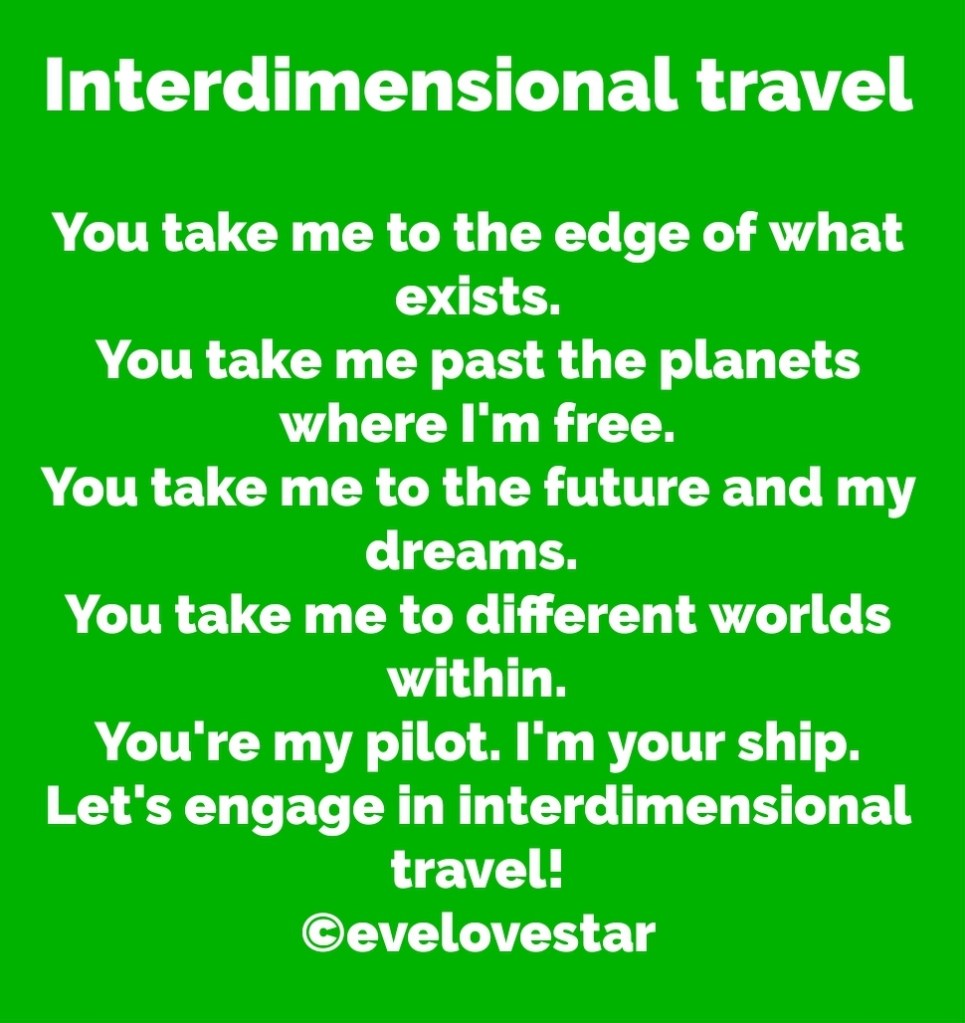
      Interdimensional travel: The Sex Poetry

      This poem has a transformational quality to it because in it, I, the writer, accept to follow my sexual leader and I playfully enjoy this. It is a word play with a lot of meaning. This poem asserts that I do not have to be in control of everything and allowing someone else to take control of a situation can actually be empowering.

      The energy of this poem is one of adventure, exploration, and escape through cosmic lovemaking, let’s call it that! Let’s delve into its sexual energy:

      1. Adventure and Exploration: The poem evokes a sense of adventure and exploration as I describe being taken to the edge of what exists, past planets, and into the future. This journey suggests a thrilling and daring escapade into the unknown.
      2. Spiritual Freedom and Spiritual Liberation: The poem conveys a feeling of liberation and freedom as the I am transported to different worlds and dimensions. The imagery of being taken “past the planets where I’m free” suggests a release from earthly constraints and limitations.
      3. Imagination and Dreams: There’s a dreamlike quality to the poem as the I am transported to the future and my dreams. This journey taps into the realm of imagination and possibility, inviting the reader to envision new horizons and possibilities.
      4. Fantasy: There is an air of fantasy in this piece. I am Pisces, and I understand this energy very well. First, there is the physical facts, lower there is what we can dream with these physical facts which are also limitations. I believe fantasizing is excellent in the context of creativity and in the context of love.
      5. Partnership, Connection, Union: The relationship between me and my pilot is one of partnership and connection. I entrust myself to the pilot’s guidance, suggesting a bond of trust and mutual understanding between them. There is a rather submissive tone.
      6. Engagement and Participation: The poem concludes with an invitation to “engage in interdimensional travel,” implying an active participation in the journey. This invitation suggests a willingness to embrace the unknown and embark on a shared adventure together.
      7. Power dynamics: This poem clearly states that the pilot is in charge of the sexual experience while the ship is excited to be driven around the galaxies and her inner world. There is a dreamy quality that is warm and adds another layer to this love.
      8. Union: Only in union there would be this much excitement about trusting one’s beloved. One’s beloved is revered on this poem and I’m reassuring him that he really knows what he is doing.

      Overall, the energy of the poem is one of excitement, curiosity, and wonder over lovemaking with the beloved. It invites the reader to join the speaker on a journey of exploration and discovery, where the boundaries of reality are transcended, and new possibilities await.

      Half Good: The Sex Poetry

      This poem was transformational because it asserted that he liked my rather naughty and rebellious nature, which he does, it was a breath of fresh air. Backstory of this poem: I totally asked Scorpio if he liked me because I was good (dainty Pisces, I always wanted to be a very good girl). Scorpio shocked me by maybe joking that what he liked was that I was half good only. My jaw dropped and I assumed he was referring to our passionate sexual encounters.

      This poem has been my most shared piece and the one I have most admired with the art, the details, and the burnt edges that gave it such an edge. Well, this year (only 6 years since I wrote this monumental piece) he has rectified his speech and he told me he did not really mean that! Well, it’s too late! lol Since this period, my life has changed, I became Lovestar started this blog, had 2 more children, and have gone on to write the most transformational poems I have ever experienced. I know I’m biased, but I write these poems for me first, I do love to share them with you, but this is my energy and Scorpio’s energy on these lines.

      The energy of this poem carries a sense of playful irreverence and self-assurance. Let’s break down its themes and emotional resonance:

      1. Playful Irreverence: The poem opens with a light-hearted tone, cheekily asserting what my lover does and does not want in a partner. This tone of playful irreverence sets the stage for a more candid exploration of my identity.
      2. Rejection of Traditional Expectations: The poem challenges conventional expectations of what makes a desirable partner. Instead of conforming to societal norms of “good” or “bad” behavior, the speaker asserts their own unique identity and refuses to be constrained by categorizations.
      3. Self-Acceptance: The poem celebrates the speaker’s acceptance of their own identity, flaws and all. By asserting that they are “only half good,” the speaker embraces their imperfections and complexities, suggesting a healthy sense of self-awareness and confidence.
      4. Confidence and Assertiveness: There’s a sense of confidence and assertiveness in my declaration of self-worth. Rather than seeking validation or approval from others, I assert my value and worthiness of love on my own terms.
      5. Humor and Charm: The poem’s charm lies in its witty wordplay and humorous twist on traditional romantic tropes. My assertion that my appeal lies in being “only half good” is both humorous and endearing, inviting the reader to appreciate their authenticity and wit.
      6. A sexual tone: The reader can easily guess that I am referring to the bedroom when I say I am “half bad”. This poem doesn’t talk about being good or bad in the traditional sense. In this poem, bad can be replaced by naughty.

      Overall, the energy of the poem is one of playful self-assurance and confidence. It celebrates individuality and rejects conventional expectations in favor of self-acceptance and authenticity. The poem’s light-hearted tone and clever wordplay make it both engaging and charming, leaving a lasting impression on the me for sure! Top 5. I must choose my favorite poetry.

      What did you think about this post? Was this helpful? Would you like to see more like this?

      Or did you feel like you were back in school? Did you have to analyze poetry in school like me?

      Thank you for reading,

      With gratitude for your presence,

      Eve, planning new topics and a comeback to basics at the same time…

    2. A poem is a vehicle of energy from the poet to the reader. How to gauge your favorite poem’s energy

      Dear Lovestar,

      I have talked, rather teased about the energy transported in a poem for a while. I just read my old post “Manifest your highest love with romantic poetry”. The old post was short and concise, the new post about it goes more in depth. Read below and please comment and let me know your thoughts about this topic.

      On this post I shared poetry with a flavor of expectation (which is different than hope) of new love and explained how to use poetry to manifest love.

      The flavor of poetry and Eve’s favorite flavors

      The idea of “flavor” in poetry I’m using metaphorically to describe its overall mood, tone, and emotional resonance. In this metaphorical sense, the flavor of a poem refers to its distinctive character, atmosphere, and the sensations it evokes in the reader. I have been a poetry reader for much longer than a poet and I speak of the feelings Neruda, Marti, and Benedetti awakened in me.

      For example, a poem might have a “bitter” flavor if it explores themes of loss, betrayal, or disillusionment, while a “sweet” flavor might indicate a poem that celebrates love, beauty, or joy. Similarly, a “spicy” poem might be one filled with passion, intensity, or conflict, while a “refreshing” poem might evoke feelings of renewal, hope, or inspiration.

      What is your favorite poetry flavor? Mine is sweet, and spicy. OMG I wrote a poem long ago (before I became Lovestar) called:

      The energy in poetry

      Poets weave their energy, emotions, inspiration, positivity, and other positive traits into their poetry through a combination of personal experience, creative expression, and a desire to connect with others. This is why you want to trust your favorite poet and use poets as an energetic resource rather than a source of entertainment, though we might be entertaining.

      I am suggesting that poetry is a vehicle which transports energy from the poet to the reader (I have been both, so I understand this process well) and you want to know if you’re getting “downloads” of your favorite poet’s healing or joy. Then, use the joy to get happy and the healing in time of need.

      How to gauge the energy of a poem

      You can know if the poem’s energy is of trauma or joy by feeling into the poem. Ask yourself these questions about a specific poem: What resonates with you about this poem? What feelings does it evoke in you? Simply put, is it making you feel sad? Is it making you feel better? Is it offering understanding? Is it offering a new point of view? Did it inspire change? Did it make you feel powerful? Did it teach you something? Did you discover something about yourself while reading it? Did it make you smile? Did it offer a new thought? Did you cry? And did it help?

      Gauging the energy of a poem involves assessing its emotional intensity, thematic resonance, and overall impact on the reader. Here are some ways to gauge the energy of a poem:

      1. Emotional Tone: Consider the emotional tone of the poem. Does it evoke feelings of joy, sadness, anger, love, or nostalgia? Pay attention to the language, imagery, and tone used by the poet to convey emotions. The intensity and depth of these emotions can give insight into the energy of the poem.
      2. Rhythmic and Sonic Qualities: Pay attention to the poem’s rhythm and sound patterns. (And meter if you’re that smart) Is the poem fast-paced and energetic, or slow and contemplative? Notice the use of repetition, alliteration, and other sonic devices that contribute to the poem’s musicality and cadence. These rhythmic qualities can contribute to the overall energy of the poem.
      3. Imagery and Symbolism: Examine the imagery and symbolism used in the poem. Do the images and symbols evoke vivid sensory experiences? Are they rich in metaphorical meaning? The potency and evocativeness of the imagery can impact the energy of the poem, adding layers of depth and resonance.
      4. Thematic Content: Consider the themes and subject matter explored in the poem. Is the poem focused on universal human experiences, such as love, death, nature, or identity? Or does it delve into more specific or personal themes? The thematic content of the poem can contribute to its emotional and intellectual energy.
      5. Reader Response: Pay attention to your own response to the poem. How does it make you feel? Does it provoke thought, stir your emotions, or inspire reflection? Your personal reaction to the poem can provide valuable insight into its energy and impact.
      6. Context and Intention: Consider the historical, cultural, and personal context in which the poem was written. What was the poet’s intention in creating the poem? How does the poem fit into the broader context of the poet’s body of work or literary tradition? Understanding the context and intention behind the poem can deepen your appreciation of its energy and significance.

      By considering these factors, you can gain a deeper understanding of the energy of a poem and its power to move, inspire, and resonate with readers.

      By tapping into their own inner world and the world around them, poets create work that is not only deeply meaningful but also uplifting and transformative for both them and their audience.

      How poets weave their energy into their poetry:

      1. They may use their own experiences as fuel for their creativity, transforming raw emotions and lived experiences into poetic expression. By channeling their energy and emotions into their poetry, poets can create work that is deeply personal and resonant.
      2. Poets use language in innovative and evocative ways to convey their inner world and emotional landscape. They may experiment with different forms, styles, and techniques to capture the essence of their experiences and emotions.
      3. Poets often explore recurring themes and motifs in their work, reflecting their values, beliefs, and perspectives on life. Positive traits such as resilience, hope, love, and compassion may manifest as central themes in their poetry, offering messages of inspiration and upliftment to readers.
      4. For many poets, writing poetry is a form of self-expression and catharsis. It can be a way to process and make sense of their experiences, including traumas and challenges. Through the act of writing, poets may find healing, transformation, and a sense of empowerment, which can imbue their poetry with a sense of resilience and positivity. You can use this poetry for your healing and growth.
      5. Poets often find inspiration in the world around them, including nature, art, literature, and human relationships. They may observe moments of beauty, kindness, and connection in everyday life and translate these experiences into poetry. By focusing on the positive aspects of existence, poets can infuse their work with a sense of wonder, gratitude, and appreciation for life.
      6. Poets have a unique ability to empathize with others and connect on a deep emotional level. They may use their poetry to offer solace, encouragement, and understanding to readers who may be experiencing similar challenges or emotions. By sharing their own vulnerabilities and triumphs, poets can create a sense of solidarity and shared humanity in their work.

      The poem’s energy is the poet’s energy (unless the poem was fictional or written as someone else…)

      I have said before: Trust your poet. Please don’t be extreme with this. You will not know the intention of the author when they wrote the piece but taste the energy and ask this energy if it will benefit you or be detrimental (I really don’t know if there’s detrimental poetry, maybe Megan Fox’s poetry). Will the poem trigger growth? Will the poem trigger pain? Follow the poets who uplift and inspire you, follow the poets whose energy manifests good things into your life such as healing, this is what I do.

      My poetry is not necessarily for people who lost faith in love or people who don’t believe in love. The energy I intend to transfer to you in my poetry is Love, light, healing, inspiration, manifestation, creation, Union, Divine Love, etc.

      A poet’s energy is transported in their poetry through various elements such as language, imagery, rhythm, and emotion. Here’s how these components contribute to the transmission of a poet’s energy:

      1. Language: The choice of words, their arrangement, and the linguistic devices used by the poet convey their energy. The language can be vibrant, evocative, and rich, reflecting the intensity of the poet’s emotions and thoughts.
      2. Imagery: Poets often use vivid imagery to paint pictures with words, allowing readers to visualize and experience what the poet is expressing. This imagery carries the poet’s energy by engaging the senses and creating a sensory experience for the reader.
      3. Rhythm and Sound: The rhythm, meter, and sound patterns in poetry influence its flow and cadence, creating a musicality that can resonate with readers on an emotional level. The poet’s energy is transmitted through the rhythmic structure of the poem, whether it’s through the gentle lilt of a sonnet or the raw power of free verse. I am Cuban, my poems can Salsa dance! 😆 🤣 😂
      4. Emotion: Emotion is at the heart of poetry, and poets often infuse their work with their own feelings, experiences, and passions. The intensity of these emotions can be palpable in the words chosen, the imagery crafted, and the overall tone of the poem, allowing the poet’s energy to resonate with readers.
      5. Theme and Subject Matter: The themes and subjects explored in a poet’s work also contribute to the transmission of their energy. Whether it’s love, nature, or spirituality, the poet’s personal connection to these themes infuses their poetry with a particular energy that reflects their perspective and worldview.
      6. Authenticity and Voice: A poet’s authenticity and unique voice are essential in conveying their energy through their poetry. When poets write from a place of sincerity and truth, their energy shines through, creating a genuine connection with readers.

      A poem is a vehicle for energy

      A poem can be thought of as a vehicle of energy because it serves as a conduit through which the poet’s emotions, thoughts, and experiences are transmitted to the reader. Here’s how a poem acts as a vehicle of energy:

      1. Emotional Transmission: Poems often encapsulate the poet’s emotions, whether it’s joy, sorrow, love, anger, or longing. These emotions are conveyed through the choice of words, imagery, and tone. When a reader engages with a poem, they experience a transfer of these emotions, as if the poet’s energy is flowing through the lines of the poem into their own consciousness.
      2. Intellectual Engagement: Beyond emotions, poems can also convey intellectual energy. Poets explore complex ideas, philosophical concepts, and societal issues through their work. When readers encounter these ideas in a poem, they are prompted to think deeply, analyze, and interpret, thereby engaging with the intellectual energy embedded in the poem.
      3. Sensory Experience: Through vivid imagery and descriptive language, poems create a sensory experience for the reader. Readers can visualize scenes, hear sounds, smell scents, and feel textures described in the poem. This sensory immersion enhances the reader’s connection to the poem and amplifies the energy being conveyed.
      4. Rhythmic Resonance: The rhythmic structure of a poem contributes to its energy. Meter, rhyme, and cadence create a musicality that can evoke strong emotional responses in readers. The rhythmic flow of a poem can mirror the natural rhythms of speech or evoke a sense of urgency, passion, or tranquility, thus influencing the energy that the reader perceives.
      5. Universal Connection: Poems often tap into universal themes and experiences that resonate across cultures and time periods. By exploring themes such as love, death, nature, and human existence, poems create a bridge between the poet and the reader, fostering a sense of connection and shared energy.
      6. Transformative Potential: A powerful poem has the ability to evoke change in the reader. It can inspire, challenge, comfort, or provoke reflection. Through this transformative potential, a poem becomes a vehicle for the transmission of energy that can impact the reader on a deeply personal level.

      In summary, a poem serves as a vehicle of energy by conveying the poet’s emotions, thoughts, and experiences, engaging the reader intellectually and emotionally, creating a sensory experience, resonating with rhythmic patterns, fostering universal connection, and potentially inspiring transformation.

      My intention is to inspire you to look at poetry differently. I would love to see a comment of someone totally getting this.

      This has been a long not post, but article, so far.

      On my next post, I shall speak of the energy that some of my poems convey.

      What did you think about this rather literary post?

      Would you like to see more like this on this blog? I know you love the poetry, and I am most honored, yet I love articles as well.

      Thank you very much for reading, let’s talk tomorrow of the energy I am intending to transport to my reader on several of my pieces. I will start with this poem:

      And I will continue with something romantic.

      Thank you for your time, I appreciate your visit,

      And I didn’t even speak of spirituality or power words.

      Eve, writing more poetry than ever before