This poem came through me during a time when my own heart was being pulled between light and darkness, between the self I thought I was and the self I had yet to meet.
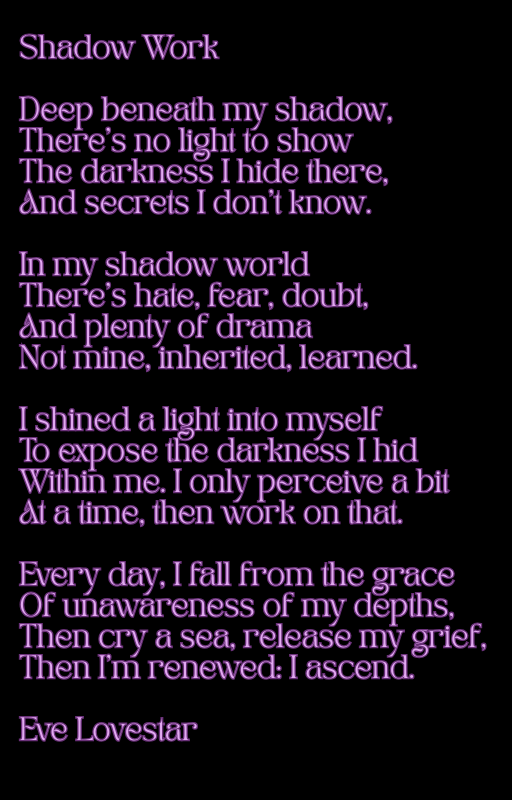
“Deep beneath my shadow, There’s no light to show The darkness I hide there, And secrets I don’t know.”
When I wrote those words, I didn’t realize I was describing what Carl Jung called the Shadow, that hidden realm of our psyche that holds everything we repress, deny, or refuse to see in ourselves. In modern spirituality, we often speak of “shadow work,” but it’s not just a trend, it’s sacred psychology. Jung said the shadow is not evil; it’s the part of us that longs for integration, love, and wholeness.
For twin flames, this becomes even more personal. Your shadow is mirrored by your counterpart. What you reject in yourself will often appear in them. That’s why shadow work is union work, it’s how we prepare for divine connection.
When I say, “I shine a light into myself,” it’s a call to self-awareness. We can’t manifest light without acknowledging what’s hidden beneath it. We must meet the parts of ourselves that ache to be loved.
This first part is your invitation: Don’t run from your darkness, hold it. The light you seek in your twin flame, in the divine, already burns in the very shadow you fear to face.
I am collecting all my Carl Jung research into ebooks and soon you will see my collection of already published Carl Jung psychology for inner healing stuff.
~~~
Follow my shop where I will soon be sharing a free eBook about this Carl Jung psychology/ spirituality works, practices, and resources.
Lately, I’ve been piecing together something that feels like a missing key between psychology and spirituality: a way to understand divine union not as a vague ideal, but as a living, breathing process that happens within us.
I realized that a large part of modern spirituality, whether people are aware of it or not, is built upon the psychological groundwork Carl Jung laid: the idea of integrating opposites, the conscious and unconscious, the masculine and feminine, spirit and matter, the shadow, archetypes, synchronicity, and more.
His concepts of the anima and animus, shadow and self, are the invisible architecture behind much of what we call awakening or union.
But I wanted to take it further.
For me, the divine cannot exist only as an idea or archetype in the mind: it must be embodied. So I turned to Aphrodite. The goddess of love is not an abstract principle; she is the pulse of beauty, attraction, sensuality, and connection that moves through the world. When I speak with her, through prayer, ritual, or quiet reflection, or when I hear her voice, I’m reminded that true union isn’t just psychological integration; it’s the merging of the psyche and the body, the mortal and the divine.
Jung gave us the map of inner union; Aphrodite gives it warmth, color, and life. He showed us the structure, she gives it breath.
The more I look at both, the more I see that divine union is not about transcending desire or escaping matter, but about sanctifying it. The masculine within us (logos, structure, intellect) seeks meaning, while the feminine (eros, feeling, embodiment) brings that meaning into form. When the two meet, within the psyche, within the heart, we don’t just understand love, we become it.
This is the psychology of divine union I am working to express: where Jung’s masculine mind meets Aphrodite’s feminine soul. It’s an alchemy of psyche and passion, of shadow and radiance, of human and goddess.
And it all begins here, in the body, in awareness, and in conversation with the divine.
My Union Research
As I continue my research into the Psychology of Divine Union, I realize it’s more than an academic or spiritual pursuit. It’s a love story. A love story between soul and mind, between the divine feminine and the conscious mind, between Jung’s language of symbols and Aphrodite’s language of feeling.
Every day, I uncover new ways these two worlds merge. Sometimes through dream work or reading Jung’s writings on anima and eros, through rarot reading and intuitive understandings, other times through prayer, ritual, and the quiet guidance of the goddess herself. Each insight feels like a conversation between mind and myth, between what we know and what we feel.
I’ll be sharing more of this journey here on my blog: reflections, insights, and love messages written in poetry. Poetry, after all, has always been my bridge between the seen and unseen, my mind and soul, my conscious and unconscious, the human, and the divine.
And I have something truly exciting in the works. I’m gathering all my notes, journal entries, poems, and studies about this topic into a larger creation: an upcoming eBook that will explore the union of Jung and Aphrodite in depth. It will be part psychological study, part spiritual reflection, and part love letter to the goddess within us all.
If you’ve been resonating with my writings, I invite you to stay close. Follow the blog, and find me on social media for daily inspirations, poetry, and updates on this unfolding journey.
The path to divine union is never a straight line. It’s a spiral, always returning us to the heart. And together, we’ll keep walking it.
 Lovestar Temple🔥 🔥