My lover, Scorpio, is an amazing hugger. I don’t think his usual type of hug is for everyone (for example, my third daughter likes only soft hugs). My lover has a powerful hug 🫂 🤗 💖 that I came to categorize as a bear hug. I love a bear hug.
There are definitely bear aspects to that man, my beloved Scorpio. For example, I came to realize that his energy never leaves me. Keep in mind that he is my twin flame, and there’s a spiritual aspect of us always available to the other.
However, I think it’s part of the Scorpio energy mixed with the spiritual element plus the telepathy. His energy feels like a huge bear protecting me right behind me.
I suspect that the “Scorpio jealousy” has to do with information they pick up telepathically and in a very mysterious type of way. I suspect that they feel, for example, a third party’s intention towards us, their women, which would make them jealous and angry, but they would not know exactly why they’re jealous. This is my personal belief, and I can’t prove it.
What are your thoughts on the Scorpio energy in love?
This is my Masculine side of this poem. This poem is how I see the Scorpio beloved. You kiss them even though you know you will fall hard and deep….
Dear Lovestar,
I would love to make this blog useful to others, yet I do not understand the needs of the readers (please comment and let me know if there is a need you have that I can meet through my writings).
Since I do not understand the needs of the readers, I simply share my experiences with love and spirit and where they intersect. This is my Love journal after all.
You might know, if you follow this blog, that I love a Scorpio man. He is my beloved twin flame, who this journal is all about. It is Scorpio season. Every year on this season, I write about Scorpio. The Scorpio flavored poetry is my favorite. Scorpio poetry is powerful, intense, and sexy….
Here is the feminine version of the poem. This is the dream of the Scorpio man: a metaphorical siren.
I just realized (and perhaps a reader is shy to comment but thinking this) that I should extend the horoscope seasonal poetry and posts into other signs because, of course, we are not all Scorpios or lovers of Scorpios. If you had that idea, thank you for the telepathy 🙂 and I will do my best. I also write Pisces poetry but not as much. I am not an expert in every sign, which is why I’m shy to write for other signs, but I will do my best.
Love potion, a powerful metaphor for irresistible Love
In poetry, a love potion often symbolizes the enchanting, irresistible, and sometimes intoxicating nature of love. It represents love’s ability to transform emotions and perceptions, evoking a sense of magic that can alter reality for those who partake in it.
Bold and confident, I decided to combine the two parts of this poem into this piece. This is Union, where Love and Spirit intersect
By invoking a love potion, I intend to convey the allure and spellbinding power of passion, hinting at love’s mystical ability to both uplift and consume. This metaphor also suggests the unpredictable or even uncontrollable forces within romantic attraction, where the “potion” can become a metaphor for the intense emotions that drive people to act beyond reason, often leading them into both joy and vulnerability.
And the inspiration for this trio of awesome poems is an old poem, which I judge as not as well written today but the message is strong and powerful. It might have been written for the previous Scorpio season.
My home is you. My only release Is with you. My peace comes Through you. I seek refuge In your arms. I touch you and I relax. My touch a tether To my safe place Which is you. I’m grounded In your Love.
Tethered
My home is you. My only release Is with you. My peace comes Through you. I seek refuge In your arms. I touch you and I relax. My touch a tether To my safe place Which is you. I'm grounded In your Love.#lovepoem#love#inlove#romance#relationships#lovelive#poetry
I was ashamed to show this poem because I didn’t like it. It lived in my Pinterest. I only kept it because of the illustration. With my new skills, I can do a better illustration today. I could also write a better poem, but I kind of like this one now. Yes, my cursive is way better, also, edging on calligraphy.
I would like to write a long thing today, but I can’t.
Here is an update:
I have been blogging about learning with my kids on my Home Education Situation blog, recently learning about Athena. Yes, it’s history 👏 🙌 👌
Collaboration with my daughter LilliLilli’s Athena. She got an A+ by writing ATHENA in capital Greek letters. I was impressed.
But also, I was rear-ended in traffic, and I’m injured, very stressed out, and I do not like to drive anymore 😕
And I have a lot of stuff going on.
I also figured a better way to teach my kids to multiply by skip counting. I will write about this on my learning blog.
This was nice. Let’s do this again.
If you can stand my poetry dumping, we can be friends, to be a part of this journal, comment, and let me know what poetry (and topics) you would like to read.
Sapho is the poetess of poetesses. I wrote a love poem for her to honor her since she is famous for writing love poems for women.
Sappho is said to have inspired the term lesbian because she was from the island of Lesbos and wrote poems for other ladies. She also wrote for men and there is not much history.
I was offended that autocorrect changed poetess to some other word.
The Word “Poetess”: A Forgotten Gem in Language and Why It Deserves a Revival
The word “poetess” evokes a sense of beauty, grace, and history, conjuring images of women who shaped poetry through the ages. While this term was once used to describe a female poet, it has largely fallen out of fashion in modern times. As we explore the ancient roots of this word, why it faded from use, and why it still holds a unique allure, we uncover a rich narrative of gender, art, and language.
Ancient History of “Poetess”\
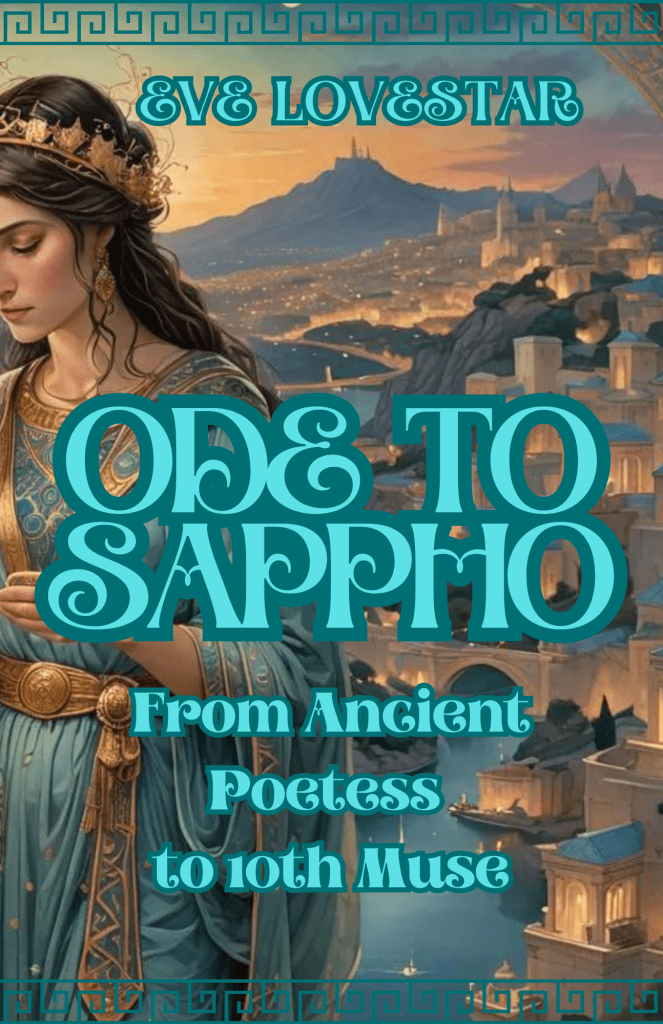
Ode to Sappho, ancient poetess
I created a free eBook to honor the greatest poetess in all of history. Download the free PDF through this link:
The word “poetess” can be traced back to ancient Greece and Rome, where poetry was a revered art form. Female poets were rare but highly respected, such as the famous Sappho of Lesbos, often regarded as one of the greatest lyric poets of antiquity.
The term itself began to gain prominence in English in the 16th and 17th centuries, as poetry became a significant part of European courtly life. Many women who expressed themselves through verse were given the title of “poetess,” a label that both honored their craft and subtly highlighted their gender. It acknowledged their talent while placing them in a separate category from male poets.
Why “Poetess” Fell Out of Use
By the 19th and 20th centuries, the word “poetess” began to carry a different weight. It became associated with a certain patronizing tone, as if female poets were less serious or skilled than their male counterparts. This shift was partly due to the changing social dynamics of the time—women were entering the literary world in greater numbers, and they sought to be recognized simply as “poets,” without the added layer of gender distinction.
The feminist movements of the 20th century further propelled this change. Many women rejected the term “poetess” as it seemed to reinforce a division between male and female creativity, implying that women’s poetry was somehow different or secondary. As equality became the goal, the neutral term “poet” was adopted by women and men alike, with “poetess” seen as outdated and unnecessary.
Why “Poetess” is Beautiful
Though the word “poetess” is seldom used today, it retains a certain beauty and elegance. Its very sound is melodic. More than that, “poetess” carries with it a sense of history, reminding us of the many women who wrote under difficult circumstances, sometimes with little recognition.
The term honors the feminine energy in poetry, which can be nurturing, passionate, intuitive, and fierce. While “poet” is a gender-neutral term that promotes equality, “poetess” offers a nod to the powerful, unique voice of women who have shaped the poetic landscape. It doesn’t diminish their work but instead celebrates the essence of femininity within the craft.
In a world where we often seek to blur distinctions in pursuit of equality, there’s something special about words that acknowledge the feminine presence without devaluing it. “Poetess” is one such word—a celebration of both poetry and womanhood, a reminder that there is beauty in difference, not inferiority.
A Call for Revival
Reclaiming the word “poetess” doesn’t mean we return to an era of gendered titles. Instead, it’s a way to celebrate the legacy of women poets throughout history. It reminds us that art, like language, evolves, and there’s power in acknowledging the past while embracing the future.
Using “poetess” today can be a statement of pride, a nod to the creative feminine spirit that has shaped much of our literary history. It is a word that holds layers of meaning—strength, elegance, artistry—inviting us to remember the women who paved the way in poetry.
In the end, the word “poetess” is not obsolete but rather a forgotten gem, one that can still shine brightly when used with reverence and understanding.
Ode to Sappho, ancient poetess
I created a free eBook to honor the greatest poetess in all of history. Download the free PDF through this link:
Italian is a very poetic language and I am learning some Italian, simply for fun. Writing poetry in Italian is easier than in Latin for me because Latin, being a dead language is much more difficult thatn Italian, even though I have barely studied Italian.
I am learning Italian because I think it would help me in my Latin learning journey, and also because I thought it would be easy, then I find the beautiful Italian poetry and figure it was meant to be!
Some themes I noticed in Italian art and music. I speak soon, but Italian music (I have been listening and singing for my learning and I will talk of it again) talks a lot about the heart (il cuore), Spanish also. In fact in Spanish, we call a beloved person mi corazon (my heart).
Italian music also mentions this word a parola which means word. It is mentioned so much that I learned the word from music and looked it up, then learned the meaning. O have to learn more but it appears that it is used as one’s word, a word, the feelings in words, the meaning, things like that. By comparison, we do not use the word “word” in English as much in poetry.
Anf the third theme I noticed was the sea. It makes sense since Italy is surrounded by sea basically. It appears that Italians love the sea and they inmortalie it in their art. In a beautiful song I heard a man singing he was going to the sea and to find a mermaid (Sono una sirena = I am a mermaid)
It is not pure luck that all these things are related. It is all meant to be. Example, Venus, the Roman was ancient Italian, basically, see why she was born at sea? Well, of course, because she was born in Greece, an island as Aphrodite. Venus (the Roman Aphrodite) was seen as the mother of Rome (the now capital of Italy).
In my poetry, I did not inlcude parola because I need to understand the word more.
English translation:
My heart lives in the sea
Its vastness, like my love,
Its calm, its color,
Its profundity, my soul.
Italian poetry. Dante and his divine comedy
Did you know that the popular Italian poet Dante Alighieri was exiled? I need to know more about this man’s history.
Dante Alighieri’s “Divine Comedy,” written in the early 14th century, is a seminal work in Italian literature and a cornerstone of Western cultural heritage. This epic poem, composed of three parts—Inferno, Purgatorio, and Paradiso—traces the journey of the soul through Hell, Purgatory, and Heaven.
Dante’s choice to write in vernacular Italian rather than Latin was revolutionary, elevating the Tuscan dialect to a prominent literary language and setting a precedent for modern Italian. His work not only advanced Italian literary tradition but also profoundly influenced subsequent writers and thinkers, solidifying his role as a pivotal figure in the evolution of Italian language and literature. I learned this from Podcast Italiano on Youtube.
Dante was exiled from Florence in 1302 due to political conflicts. He had been involved in the complex political and factional struggles of Florence, which led to his banishment. The “Divine Comedy” was written during his exile and is often seen as a reflection of his personal and political grievances, as well as his broader philosophical and theological concerns. The work itself did not cause his exile, but it did encapsulate his views on justice, politics, and morality, which were influenced by his experiences of exile.
But was he exiled because of his poetry? Was he using poetry to attack his political enemies?
The fault is of politics, obviously! Yet, poets will poet. And yes, I used poet as a verb.
What is a tailpiece? It’s the decorative design under a poem (or any literature). Sometimes they are very fancy and complex, sometimes they’re very cute, sometimes they look ornate like a baroque church.
As a lover of literature and classic literature, tailpieces were on every book I remember. They made a really big impression on me, and since then, I always do a simple tailpiece when I write by hand.
I use the tailpiece as a sign that the poem (or any other handwriting) is a finished piece. If I do a poem without a tailpiece, it means it’s incomplete, or I want to work on it more.
Tailpieces on my poetry journal
My tailpieces compliment my cursive, and I use the same flourishes. My tailpiece themes are swirls, hearts, dots, and flowers. I like to design one on the spot and don’t like to copy them. I like unique ones.
Three hearts with swirlsHeart with swirlsInfinity sign with swirlSwirls with dotsFlower with swirlsInfinity sign with swirlsA swirl with dots designAsymmetrical swirls
Digital tailpieces
I realized that since tailpieces are such a big part of my literary experience, I should use them in my blogging, ebooks, and articles, too. I am going to create a library of them. These digital ones I just created on the Sketchbook app.
Sunflower Love digital calligraphy My name as a tailpiece? Perfect idea 💡 My name heart signature is cute enough. Digital CalligraphyRose with swirlsGolden heart with swirlsSimple swirl
Poetry journal tailpieces video on my girls’ channel




 Lovestar Temple🔥 🔥