Thousands of women are walking this path. Your seat is waiting.
P.S. Comment below if this stirred something in you. I read every one.
(Join me on Ko-fi for weekly Goddess Messages: tarot, oracle, intuitive downloads from the Divine Feminine. Free temple, premium depths. Your love era starts now.)
I just released a new Valentine’s offer on Patreon: a soft, sacred space for love letters, goddess transmissions, and real-world romance for grown hearts.
Inside this mini-offering you will find:
A gentle heart-opening meditation to clear your mind and soften your chest before you write.
Channeled letters from Venus to four different hearts: the romantic, the single one, the long-term lover, and the heart-healing one.
Practical, soulful tips for writing your own love letter without shame, tests, or toxic patterns.
Prompts and examples for letters to yourself, to a current partner, and to a future beloved, turning manifestation into sacred communication instead of scripting.
Conversation / “love night” prompts for couples who want to open up, turn on, and grow closer without cringing.
A simple ritual for couples and a visualization ritual for singles to anchor everything in your body and your life.
This is for you if:
You secretly love romance but are tired of the plastic version of Valentine’s.
You want to give a love letter that feels honest, adult, and tender, not cheesy.
You are single and want to call in love while actually honoring your own heart first.
You are healing from old patterns and want your next chapter in love to feel different.
You do not need a perfect relationship to step into this. You only need a heart that is ready to tell the truth more beautifully.
If this is tugging at you, come into the temple and claim your copy. Your letter, your ritual, your next version of love are waiting inside.
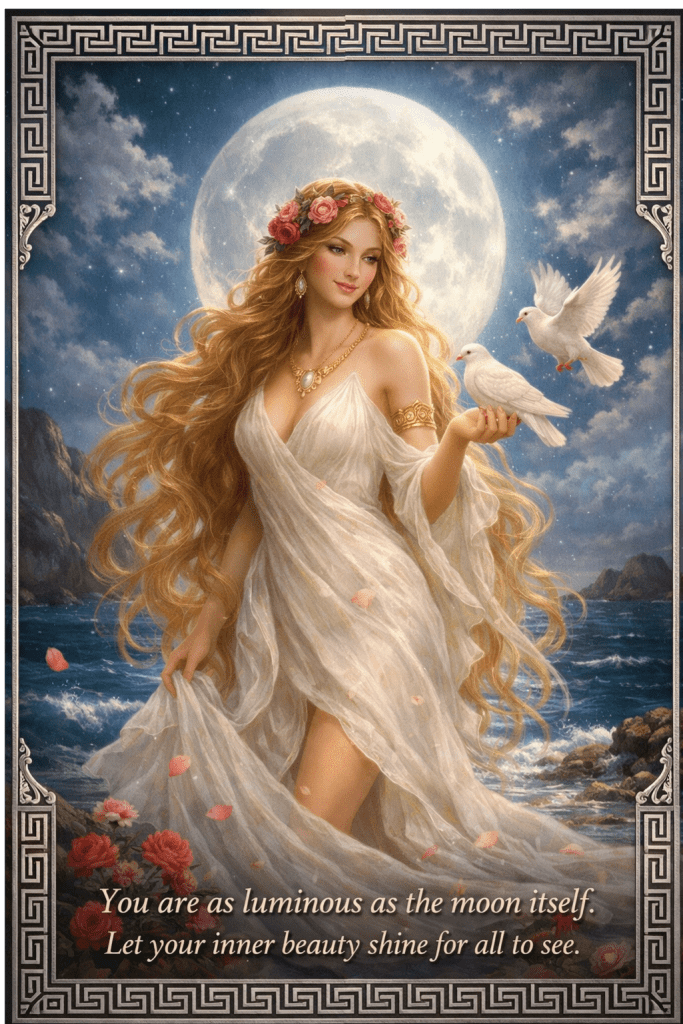
Before the cards are opened, before the flowers are chosen, before you decide whether you are “alone” or “taken” this year, Aphrodite is already present.
Valentine’s season is not a test of worthiness, but a reminder that love is a living force moving through every part of your life: in desire, in friendship, in beauty, in the quiet ways you care for yourself.
Long before roses and paper hearts, this season carried the pulse of fertility, devotion, and longing. And her message remains the same: you are not waiting for love to arrive, you are already standing inside it.
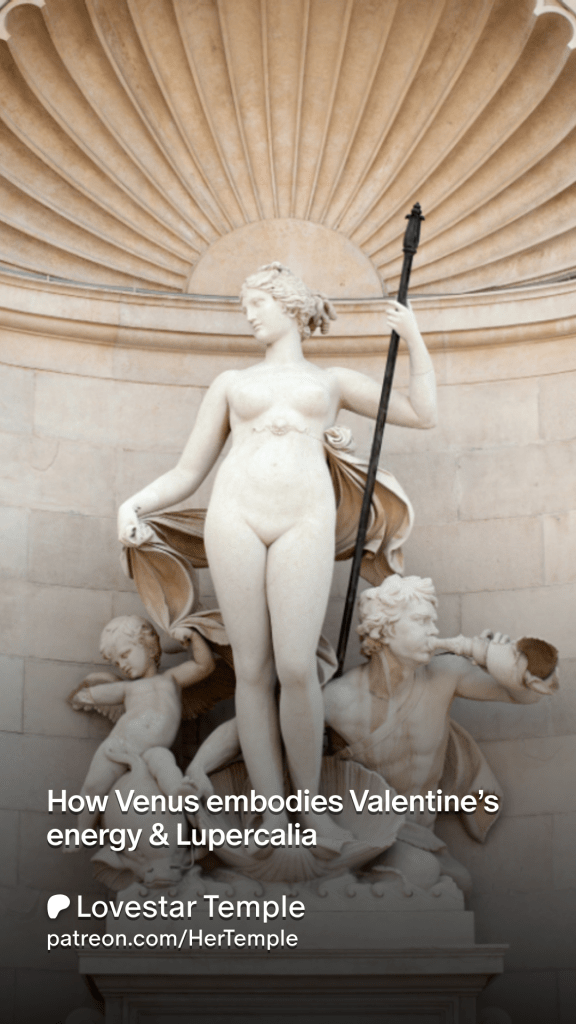
Every February, a specific energy takes hold: flowers, love notes, fantasies of perfect weddings, and the deep hunger to be chosen. This isn’t just a modern marketing creation. Beneath the surface of Valentine’s season pulses an ancient current, the enduring power of the Roman goddess Venus.
Venus was far more than a “love goddess.” She embodied desire, beauty, fertility, prosperity, and victory. She was both a deeply personal and a powerfully civic force, considered the ancestress of the Roman people. When we focus on romance and union in February, we are reactivating her field.
The Layers Beneath Valentine’s Day:
While the date February 14th comes from Christian martyrs, its romantic tone was a medieval addition, creating a perfect bridge for older, pagan energies to flow into a new form.
The ancient Roman festival of Lupercalia (February 15th) celebrated fertility and vitality with wild, public rites. Though not directly honoring Venus, its core concern, the pairing of bodies and futures, sits firmly within her domain.
Over centuries, the intense seasonal focus on fertility and pairing from Lupercalia and the divine authority of Venus gradually softened and reframed into the romantic ceremonies we know today.
Our Modern Rituals Are Roman at Heart: The cherubs (Cupid was Venus’s son), the hearts, the belief that love deserves grand gestures, legal recognition, and sacred symbols, these are all inheritances from a Roman worldview. Love was seen as a destiny-shaping force worthy of public ceremony and divine blessing, an intuition we still echo every February.
Ready to explore the full story? The premium post, “Venus, Heart of February,” dives deep into:
The mythic and political power of Venus.
The fascinating, debated link between Lupercalia and Valentine’s Day.
How Cupid represents love’s irrational, piercing force.
The direct line from Roman wedding rituals to our modern “white wedding” aesthetics.
Discover how the goddess of love, beauty, and union still shapes our deepest February longings.
True love flourishes not in grand gestures but in emotional safety, the quiet confidence that your heart is understood and protected. Emotional safety forms when partners listen to understand, not to defend, and respond to vulnerability with gentleness rather than analysis.
Psychology calls these moments “bids for connection” tiny opportunities to turn toward each other that, over time, create the deep security we all crave.
A relationship grounded in safety allows both partners to express desires, fears, and flaws without fear of judgment. It’s presence, consistency, and compassion woven into the fabric of daily life. Instead of asking “How do I fix this?” try asking, “How can I help you feel seen?” The answer will often say more about your love than any solution ever could.
Lovestar Temple is open, join for free today
Lovestar Temple is a sacred sanctuary devoted to goddess activation and the art of feminine worship. Here, love is both the path and the practice, a place to remember your divinity, soften into self-reverence, and awaken the radiant current of love that lives within you. Enter the temple to deepen your connection to your feminine essence, embody devotion, and activate your love life from the inside out.
At its core, conscious love is a partnership built on awareness, intention, and responsibility. It is the antithesis of the romantic fantasy where a perfect partner completes us and erases all our problems. Instead, it recognizes that a relationship is a crucible for growth, and the person beside us is both a mirror and a teacher.
The Pillars of Conscious Love:
Awareness Over Autopilot: Most relationship conflicts are not unique; they are cycles we replay unconsciously. Conscious love demands that we become aware of our triggers, our childhood wounds, and our communication patterns. It asks, “Why does this specific thing cause me to react so strongly?” instead of “Why are you doing this to me?”
Intention Over Impulse: Love is not just a feeling that comes and goes; it is a series of intentional choices. It is the choice to speak with kindness when you feel like snapping, the choice to listen when you want to defend, and the choice to prioritize the relationship even when it’s inconvenient.
Responsibility Over Blame: In unconscious relationships, the default mode is blame. Conscious love flips this script. It involves taking 100% responsibility for your 50% of the dynamic. This means owning your feelings, your reactions, and your contributions to conflict, without expecting your partner to “fix” you.
Expansion, Not Completion: The conscious love narrative is not “you complete me,” but “you complement me.” It is built on the foundation of two whole individuals who choose to share their lives, not two halves searching for wholeness in another. The goal is mutual growth and expansion, not enmeshment and dependency.
Thank you for reading and follow for more reads about Love, romance, and Union.
Lovestar Temple is opening. A sanctuary for love, devotion, sensuality, and soul-awakening. I’m channeling goddess messages, rituals, union teachings, erotic healing, and monthly practices to guide you into deeper love – with yourself and with another.
If you feel the call, join the temple: Exclusive Patreon rituals Goddess messages Private union teachings
Enter the temple. Your heart already knows the way.
While the Greek gods often command the spotlight, the goddesses were the true architects of destiny, wielding power that shaped everything from the harvest to the human soul. They were far more than just consorts and mothers; they were warriors, queens, scholars, and hunters. Today, we celebrate the might and complexity of the Olympian goddesses.
Hera, the Queen of Olympus, was a force to be reckoned with, embodying the sanctity and struggles of marriage. Demeter’s grief could halt the seasons themselves, showing the profound connection between divine emotion and the natural world. Aphrodite wielded love and desire as a universal, unstoppable power, influencing both gods and mortals alike.
Then there were the virgin goddesses, who claimed autonomy over their own bodies and domains. Athena, born from Zeus’s head, was the patron of wisdom, strategic war, and civilization. Artemis, the fierce huntress, roamed the wilds with her nymphs, protector of young women and the untamed earth. Hestia, though she gave up her throne, was the gentle, essential heart of every home and city.
These goddesses, along with chthonic (underworld) powers like Persephone and Hekate, present a complete picture of female divinity—one of strength, intelligence, and immense influence.
Next time, we’ll step away from the drama of Olympus to meet the gentle and essential Hestia.
What is premium content on my Patreon is goddess devotion, so you can read everything I am learning about goddesses, and I did decide to create a thing about as many gods as I can, but as you know, I love the goddesses, not the gods.
The 12 Olympians: The A-List of Ancient Greece
When we hear names like Zeus, Athena, or Apollo, we often picture majestic marble statues or dramatic scenes from movies. But for the ancient Greeks, these gods were the fundamental forces that shaped their world, their culture, and their understanding of life itself. They were a complex family of immortals, each with their own domain, personality, and flaws, reflecting the full spectrum of human experience.
Today, we’re starting a journey to meet the Olympians, the divine rulers who called Mount Olympus their home.
Where Did the Gods Come From? It All Started with Chaos
Before the familiar gods of Olympus, there was only Chaos—a void of nothingness. From Chaos emerged the first primordial deities, including Gaia (Earth) and Ouranos (Sky). Their union created the Titans, the first rulers of the cosmos.
The most important Titan, Cronus, overthrew his father Ouranos. Fearing a prophecy that he too would be overthrown by his own child, Cronus swallowed each of his children at birth. His wife, Rhea, desperate to save her youngest, Zeus, tricked Cronus by giving him a stone wrapped in swaddling clothes. The infant Zeus was hidden away and raised in secret.
When he came of age, Zeus forced Cronus to disgorge his siblings: Hestia, Demeter, Hera, Hades, and Poseidon. What followed was a cataclysmic war known as the Titanomachy, where Zeus and his siblings fought the Titans for supremacy. Victorious, the three brothers drew lots to divide the world:
Zeus: King of the Gods and ruler of the Sky.
Poseidon: God of the Seas, Earthquakes, and Horses.
Hades: God of the Underworld and ruler of the Dead.
With the cosmos divided, a new era began—the age of the Olympian Gods.
The 12 Olympians: The A-List of Ancient Greece
While the number sometimes varies, the canonical Twelve Olympians were the principal deities of the Greek pantheon. They were not distant, all-powerful beings; they were passionate, jealous, generous, and vengeful.
Here is a quick introduction to the core twelve:
Zeus: The ruler of the gods, god of the sky, lightning, thunder, law, and order. His weapon is the thunderbolt.
Hera: The queen of the gods, goddess of marriage, women, and family. She was both the wife and sister of Zeus.
Poseidon: God of the sea, rivers, floods, droughts, and earthquakes. His symbol is the mighty trident.
Demeter: Goddess of the harvest, agriculture, and the sacred law of the cycle of life and death.
Athena: Goddess of wisdom, handicraft, and strategic warfare. She was born, fully armed, from Zeus’s forehead.
Apollo: God of light, the sun, prophecy, philosophy, archery, medicine, music, and poetry.
Artemis: Goddess of the hunt, the wilderness, wild animals, the moon, and chastity. Apollo’s twin sister.
Ares: God of war, specifically the violent and brutal aspects of battle.
Aphrodite: Goddess of love, beauty, pleasure, and procreation. She was born from the sea foam.
Hephaestus: The master blacksmith and craftsman of the gods, god of fire, metalworking, and sculpture.
Hermes: The messenger of the gods, god of trade, thieves, travelers, sports, and border crossings.
Dionysus: The youngest Olympian, god of wine, viticulture, fertility, ritual madness, and religious ecstasy.
(Hades, while a major god, did not reside on Mount Olympus and is typically not counted among the Twelve. Hestia, the original Olympian of the hearth, gave up her seat to Dionysus to maintain peace.)
The Greek gods are timeless because they are so profoundly human. Their myths are not just entertaining stories; they are archetypal narratives that explore love, loss, ambition, jealousy, and the struggle for power. They were used to explain natural phenomena (why the seasons change, why volcanoes erupt) and to teach moral and social lessons.
From Renaissance art to modern-day psychology (think “Oedipus Complex” or “Narcissism”), the legacy of these deities is woven into the very fabric of Western civilization.
In our next post, we’ll dive deeper into the tumultuous life of the King of the Gods himself: Zeus! We’ll explore his many loves, his powerful children, and why he was both revered and feared.
Want to Dive Deeper? Here are some excellent resources for further research:
Theoi Greek Mythology: An extensive and meticulously researched resource on the gods, spirits, and creatures of Greek mythology, complete with original texts.
When we hear names like Zeus, Athena, or Apollo, we often picture majestic marble statues or dramatic scenes from movies. But for the ancient Greeks, these gods were the fundamental forces that shaped their world, their culture, and their understanding of life itself. They were a complex family of immortals, each with their own domain, personality, and flaws, reflecting the full spectrum of human experience.
Today, we’re starting a journey to meet the Olympians, the divine rulers who called Mount Olympus their home.
Where Did the Gods Come From? It All Started with Chaos
Before the familiar gods of Olympus, there was only Chaos.
From Chaos emerged the first primordial deities, including Gaia (Earth) and Ouranos (Sky). Their union created the Titans, the first rulers of the cosmos.
The most important Titan, Cronus, overthrew his father Ouranos. Fearing a prophecy that he too would be overthrown by his own child, Cronus swallowed each of his children at birth. His wife, Rhea, desperate to save her youngest, Zeus, tricked Cronus by giving him a stone wrapped in swaddling clothes. The infant Zeus was hidden away and raised in secret.
When he came of age, Zeus forced Cronus to disgorge his siblings: Hestia, Demeter, Hera, Hades, and Poseidon. What followed was a cataclysmic war known as the Titanomachy, where Zeus and his siblings fought the Titans for supremacy. Victorious, the three brothers drew lots to divide the world:
Zeus: King of the Gods and ruler of the Sky.
Poseidon: God of the Seas, Earthquakes, and Horses.
Hades: God of the Underworld and ruler of the Dead.
With the cosmos divided, a new era began, the age of the Olympian Gods.
Want to Dive Deeper? Here are some excellent resources for further research:
Theoi Greek Mythology: An extensive and meticulously researched resource on the gods, spirits, and creatures of Greek mythology, complete with original texts.




 Lovestar Temple🔥 🔥