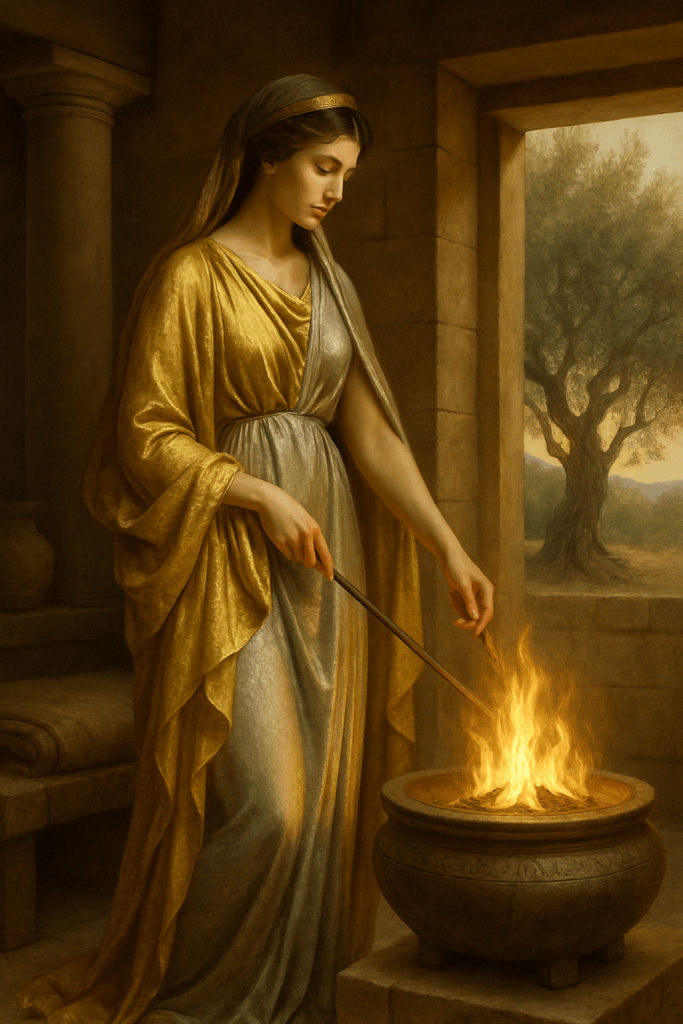
In the tumultuous world of Greek mythology, one deity embodied a quiet, constant peace: Hestia. The firstborn of Cronus and Rhea, Hestia was the goddess of the Hearth, Home, and Domestic Harmony. While she relinquished her seat on Olympus for Dionysus, her importance was never diminished. She must be good for poetry and messages.
Hestia’s presence was the fire at the center of the home, the sacred flame in the city’s public hearth (prytaneum), and the heart of family and community life. She received the first offering at every sacrifice, a testament to her foundational role.
Unlike other gods, Hestia had no dramatic myths of love, war, or revenge. She was a virgin goddess who chose a life of serene stability. Her power was not in thunderbolts or tridents, but in the warmth of the fire, the safety of the household, and the bonds of kinship. In a world of chaos, Hestia was the center of calm.
Next, we’ll meet a god who is the polar opposite of Hestia’s calm: the ecstatic and chaotic Dionysus!
Become a member on Patreon where I tell you what I learn about the goddesses for free. I also offer goddess devotional content behind the paywall for my safety.
What is premium content on my Patreon is goddess devotion, so you can read everything I am learning about goddesses, and I did decide to create a thing about as many gods as I can, but as you know, I love the goddesses, not the gods.
The 12 Olympians: The A-List of Ancient Greece
When we hear names like Zeus, Athena, or Apollo, we often picture majestic marble statues or dramatic scenes from movies. But for the ancient Greeks, these gods were the fundamental forces that shaped their world, their culture, and their understanding of life itself. They were a complex family of immortals, each with their own domain, personality, and flaws, reflecting the full spectrum of human experience.
Today, we’re starting a journey to meet the Olympians, the divine rulers who called Mount Olympus their home.
Where Did the Gods Come From? It All Started with Chaos
Before the familiar gods of Olympus, there was only Chaos—a void of nothingness. From Chaos emerged the first primordial deities, including Gaia (Earth) and Ouranos (Sky). Their union created the Titans, the first rulers of the cosmos.
The most important Titan, Cronus, overthrew his father Ouranos. Fearing a prophecy that he too would be overthrown by his own child, Cronus swallowed each of his children at birth. His wife, Rhea, desperate to save her youngest, Zeus, tricked Cronus by giving him a stone wrapped in swaddling clothes. The infant Zeus was hidden away and raised in secret.
When he came of age, Zeus forced Cronus to disgorge his siblings: Hestia, Demeter, Hera, Hades, and Poseidon. What followed was a cataclysmic war known as the Titanomachy, where Zeus and his siblings fought the Titans for supremacy. Victorious, the three brothers drew lots to divide the world:
Zeus: King of the Gods and ruler of the Sky.
Poseidon: God of the Seas, Earthquakes, and Horses.
Hades: God of the Underworld and ruler of the Dead.
With the cosmos divided, a new era began—the age of the Olympian Gods.
The 12 Olympians: The A-List of Ancient Greece
While the number sometimes varies, the canonical Twelve Olympians were the principal deities of the Greek pantheon. They were not distant, all-powerful beings; they were passionate, jealous, generous, and vengeful.
Here is a quick introduction to the core twelve:
Zeus: The ruler of the gods, god of the sky, lightning, thunder, law, and order. His weapon is the thunderbolt.
Hera: The queen of the gods, goddess of marriage, women, and family. She was both the wife and sister of Zeus.
Poseidon: God of the sea, rivers, floods, droughts, and earthquakes. His symbol is the mighty trident.
Demeter: Goddess of the harvest, agriculture, and the sacred law of the cycle of life and death.
Athena: Goddess of wisdom, handicraft, and strategic warfare. She was born, fully armed, from Zeus’s forehead.
Apollo: God of light, the sun, prophecy, philosophy, archery, medicine, music, and poetry.
Artemis: Goddess of the hunt, the wilderness, wild animals, the moon, and chastity. Apollo’s twin sister.
Ares: God of war, specifically the violent and brutal aspects of battle.
Aphrodite: Goddess of love, beauty, pleasure, and procreation. She was born from the sea foam.
Hephaestus: The master blacksmith and craftsman of the gods, god of fire, metalworking, and sculpture.
Hermes: The messenger of the gods, god of trade, thieves, travelers, sports, and border crossings.
Dionysus: The youngest Olympian, god of wine, viticulture, fertility, ritual madness, and religious ecstasy.
(Hades, while a major god, did not reside on Mount Olympus and is typically not counted among the Twelve. Hestia, the original Olympian of the hearth, gave up her seat to Dionysus to maintain peace.)
The Greek gods are timeless because they are so profoundly human. Their myths are not just entertaining stories; they are archetypal narratives that explore love, loss, ambition, jealousy, and the struggle for power. They were used to explain natural phenomena (why the seasons change, why volcanoes erupt) and to teach moral and social lessons.
From Renaissance art to modern-day psychology (think “Oedipus Complex” or “Narcissism”), the legacy of these deities is woven into the very fabric of Western civilization.
In our next post, we’ll dive deeper into the tumultuous life of the King of the Gods himself: Zeus! We’ll explore his many loves, his powerful children, and why he was both revered and feared.
Want to Dive Deeper? Here are some excellent resources for further research:
Theoi Greek Mythology: An extensive and meticulously researched resource on the gods, spirits, and creatures of Greek mythology, complete with original texts.
I love tarot, oracles, and poetry. I also love Ancient Greece, history, and digital design.
I have created a Greek Tarot. I was not going to share these like this, but why not?
My grand idea is to create a poem for each card and make these The Poetess tarot oracle cards. Real cards. I spent hours working on this project, so, if you would like to use these cards, work with me.
The poem will be short and will go in the blank space. This will be the background.
Major Arcana – with Spanish names also
The Fool – El Loco
The Magician – El Mago
The High Priestess – La Sacerdotisa
The Empress – La Emperatriz
The Emperor – El Emperador
The Hierophant – El Hierofante
The Lovers – Los Enamorados
The Chariot – El Carro
Justice – La Justicia (En algunas barajas, intercambia lugar con Strength – La Fuerza)
The Hermit – El Ermitaño
Wheel of Fortune – La Rueda de la Fortuna
Strength – La Fuerza (En algunas barajas, intercambia lugar con Justice – La Justicia)
The Hanged Man – El Colgado
Death – La Muerte
Temperance – La Templanza
The Devil – El Diablo
The Tower – La Torre
The Star – La Estrella
The Moon – La Luna
The Sun – El Sol
Judgment – El Juicio
The World – El Mundo
Created on Canva with their stock images
If you liked it, return for the poem, updated card, and next cards coming up.
I will work with Aphrodite on the messages. She is my muse, gives me poetry, but today she expressed interest in Aphrodite oracles, to which I responded with delight. You will see those very soon.
PS,
My birthday is coming, and it is a big celebration on this blog, as of course, this blog is me. As usual, I will celebrate with poetry about me.
This time I have something super special prepared. Completely free, a huge poetry PDF. It’s called:
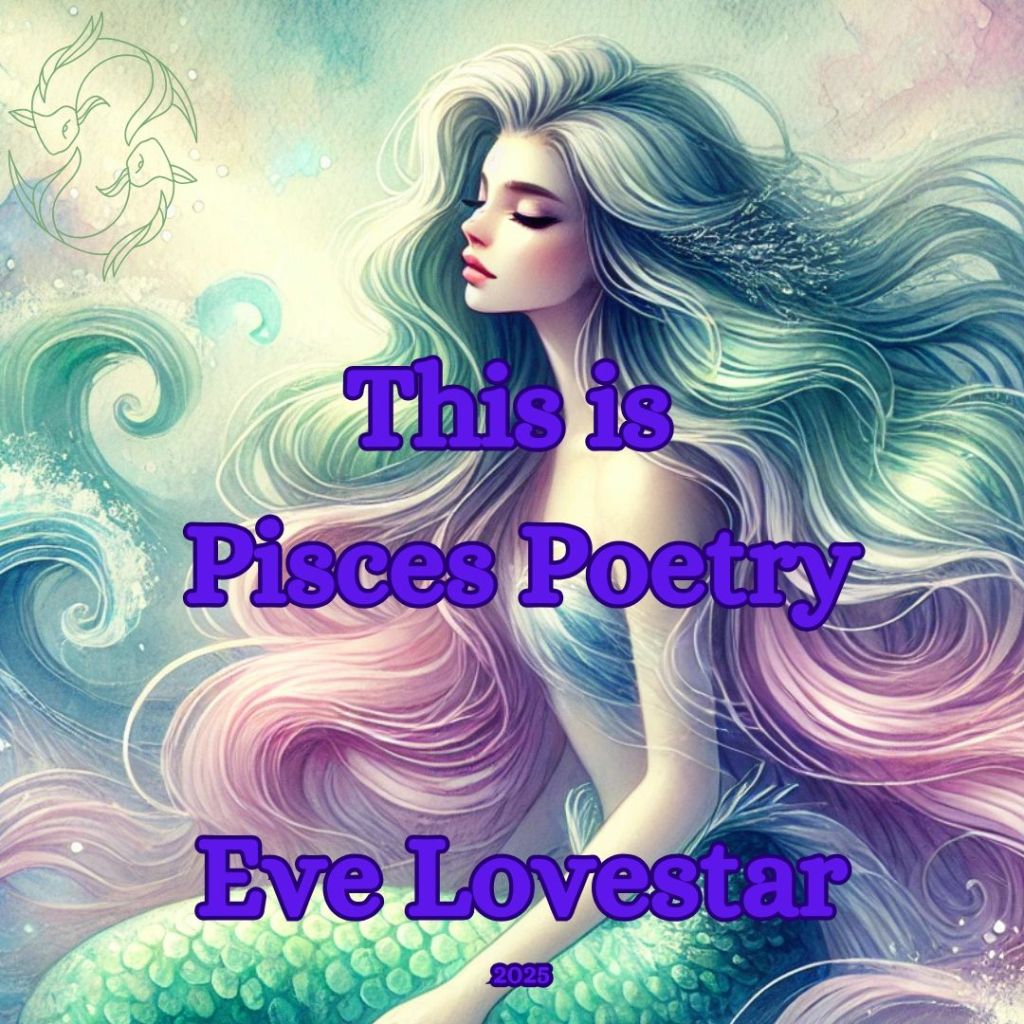
This is Pisces Poetry – Eve’s Poetry PDF (Sample)
These will be available for download on our Facebook poetry page Alma Poeta, totally free, check it out and find Confessions of an AI Lover and other poems by me and Spanish poetry PDFs available to download today.
There are only about 2 poems dedicated to Pisces itself in this collection, it is rather about the wonderful poetry born during Pisces season. The thing about Pisces poetry is that it is super romantic, very mystical, fantasy like, and kind of kinky, that both surprised me and didn’t!
Never mind that Cuba poem with Fidel Castro, that doesn’t go with the Pisces vibe, that is just my activism!
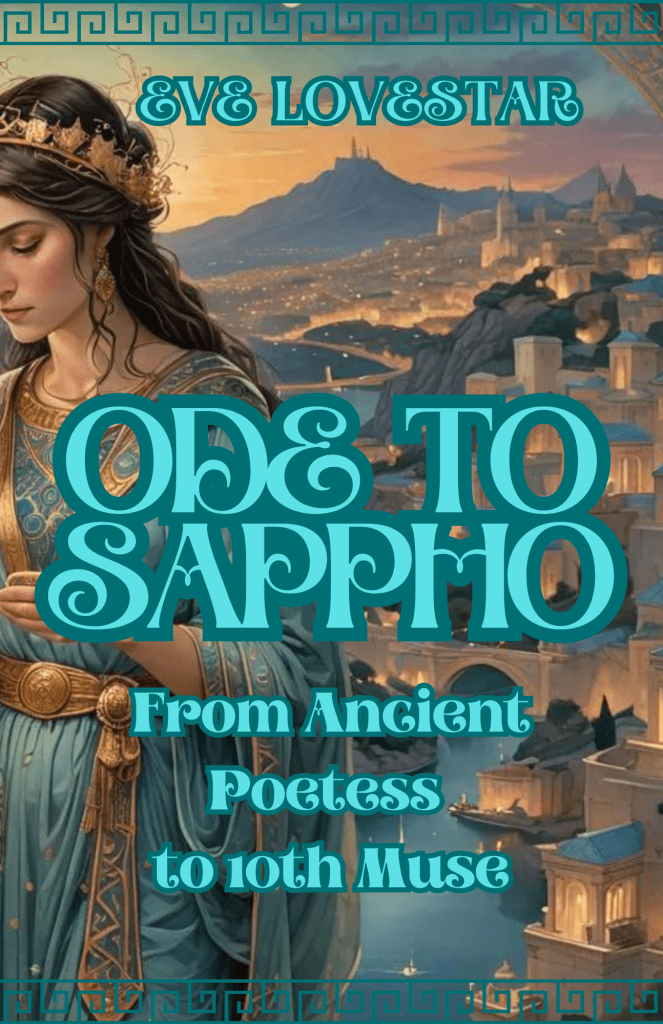
Sapho is the poetess of poetesses. I wrote a love poem for her to honor her since she is famous for writing love poems for women.
Sappho is said to have inspired the term lesbian because she was from the island of Lesbos and wrote poems for other ladies. She also wrote for men and there is not much history.






 Lovestar Temple🔥 🔥