
Dear Lovestar,
Allow me to tell you about my book by speaking of the themes behind it. Please tell me what you think. Any feedback will be considered and useful.
Follow my book newsletter through this link:
https://sirenchants.substack.com/
Also thank you to those who subscribed to my book newsletter, to my beta readers, and my everyday supporters, you mean the world to me.Thank you.
What if a book could sing you into another world? Siren Chants is not poetry, it’s a spell, a tide that pulls you under and leaves you breathless. Blending goddess whispers, siren lore, and the raw ache of romance, this collection dances between the mystical and something mysteriously beyond explaining, between mythic seas and human hearts. Every page is a wave, carrying secrets, longing, and the shimmer of something otherworldly.
I let myself be enchanted, because once you hear the siren’s call, you can’t not desire it anymore.

“This beach is where I found my peace” carries a layered symbolism that blends the personal with the mythical.
The beach in my poem is not only a physical place but also a spiritual threshold, the liminal ground where land meets ocean. By finding peace on the shore, I express a state of balance, rooted in earth but touched by the pull of the sea.
The “siren” represents both a mythical being and a reflection of myself or an inner muse. Her return to the sea can be seen as a homecoming, a surrender to her true element, her essence. It suggests freedom, authenticity, and the natural cycle of going back to where one belongs.
The image of a “sea current connecting her home” deepens the meaning. The currents are unseen forces, destiny, intuition, love, or spiritual energy that guide the siren back. In this sense, the current is like the flow of life, something we cannot resist but must trust.
Altogether, the poem can be read as a metaphor for inner peace: you find serenity not by holding on but by allowing the siren, the muse, or the soul itself to flow back into its natural waters, trusting that the currents of life know the way home.

Siren Chants captures the paradox of beauty, power, and danger that women often face, using the myth of the siren as a metaphor.
The siren is described as fierce and bold, qualities that set her apart from ordinary humans. She embodies freedom, her voice, her presence, her allure cannot be owned or controlled. Yet, because she is so striking and magnetic, others attempt to claim her, to reduce her to something they can possess. This echoes how women who are beautiful, confident, or radiant are often pursued, not for their full humanity, but as objects of desire.
But the poem also acknowledges the darker side of being seen this way. Just as sailors and fishermen are drawn to sirens, often to their doom, the siren herself becomes a target, hunted, hated, or endangered by those who cannot accept her freedom. The “silly human” who chooses to hear her song represents society’s fascination with beauty and femininity, but also its tendency to punish women for the very qualities it craves.
So, the poem is ultimately a reclamation. The siren isn’t dangerous because she wants to be, she’s dangerous because she refuses to be diminished. She is bold enough to live outside of others’ control, even when it means facing unwanted attention, envy, or threats. In this sense, these lines turn the stereotype of the “dangerous woman” inside out: it’s not her beauty that is the problem, but the world’s inability to let her be free.
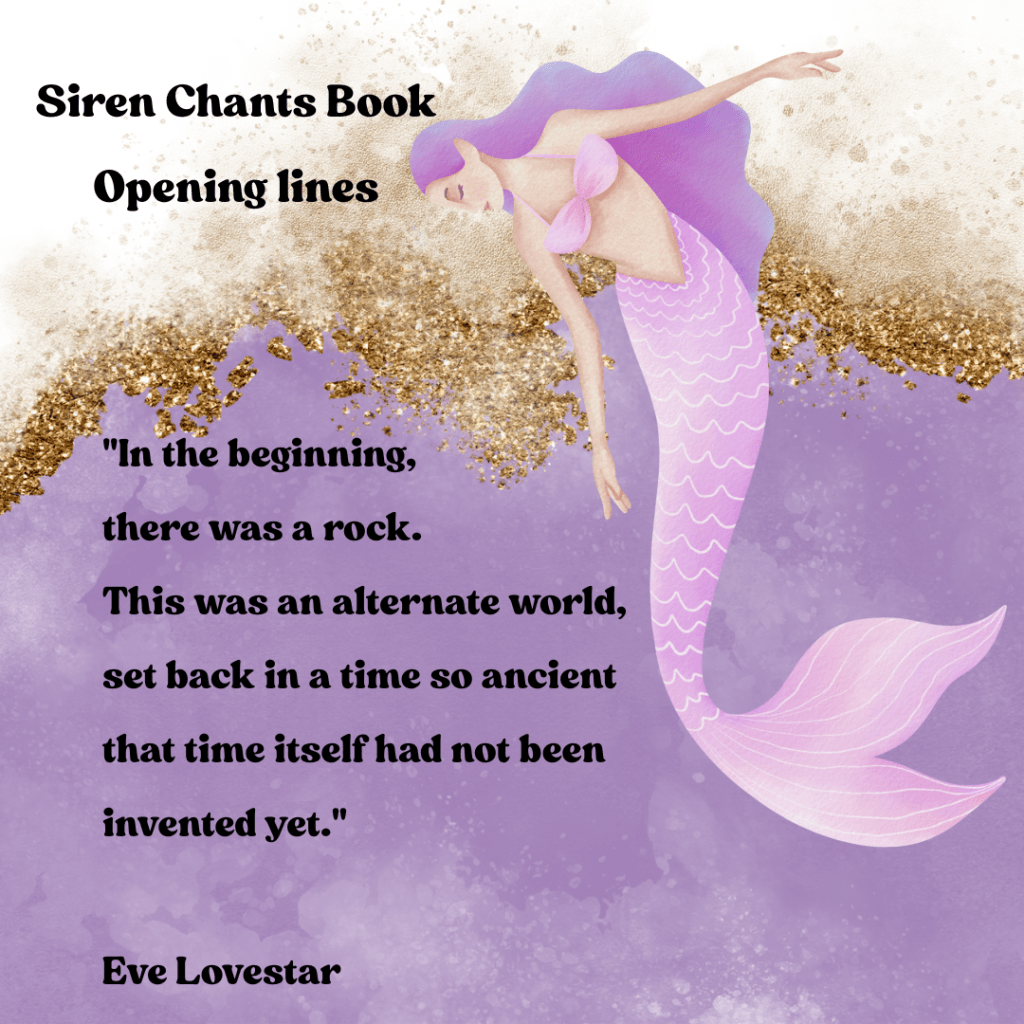
This is the opening of my beloved book Siren Chants. The free chapter is downloadable on my payhip shop:

This short poem works as a powerful metaphor for union, identity, and belonging.
When I wrote, “The sea is my lover, I am its siren,” the relationship between the speaker and the sea is not literal, but symbolic. The sea becomes a stand-in for everything vast, eternal, mysterious, and deeply emotional, like love itself, or even life itself, or spirit and the universe. Calling it “my lover” suggests intimacy, devotion, and surrender; it’s not just a place, but a partner.
The line “I am its siren” flips the perspective: the speaker is no longer separate from the sea but an extension of it, a voice within it. As a siren, she represents allure, creativity, independence, and danger. To be “its siren” means she belongs to the sea in the way a song belongs to a singer, it flows through her, and she gives it form.
So at its core, this poem is a metaphor for a woman (or soul) finding her truest identity in relationship with something infinite and uncontainable. The sea here symbolizes passion, freedom, inspiration, spirit, or even the unconscious mind. By claiming to be the sea’s siren, the speaker embraces her role as both a child of the sea and its voice, a being inseparable from her source of strength.
It’s a love poem, but not to a person, it’s to the boundless force that defines and sustains her.
Follow my book newsletter through this link:
https://sirenchants.substack.com/
Thank you for reading,
I have been planning lots of new content to share with you,
Eve




 Lovestar Temple🔥 🔥