While the Greek gods often command the spotlight, the goddesses were the true architects of destiny, wielding power that shaped everything from the harvest to the human soul. They were far more than just consorts and mothers; they were warriors, queens, scholars, and hunters. Today, we celebrate the might and complexity of the Olympian goddesses.
Hera, the Queen of Olympus, was a force to be reckoned with, embodying the sanctity and struggles of marriage. Demeter’s grief could halt the seasons themselves, showing the profound connection between divine emotion and the natural world. Aphrodite wielded love and desire as a universal, unstoppable power, influencing both gods and mortals alike.
Then there were the virgin goddesses, who claimed autonomy over their own bodies and domains. Athena, born from Zeus’s head, was the patron of wisdom, strategic war, and civilization. Artemis, the fierce huntress, roamed the wilds with her nymphs, protector of young women and the untamed earth. Hestia, though she gave up her throne, was the gentle, essential heart of every home and city.
These goddesses, along with chthonic (underworld) powers like Persephone and Hekate, present a complete picture of female divinity—one of strength, intelligence, and immense influence.
Next time, we’ll step away from the drama of Olympus to meet the gentle and essential Hestia.
Patreon + Ko-fi memberships give you full access to: Weekly goddess downloads Love mastery teachings Flirting & intimacy lessons Moon rituals Union, soulmate, and marriage wisdom
Step into your power. Join Lovestar Temple: where women rise in love.
We are all born with a deep, innate capacity for love. Yet, for something so fundamental to the human experience, we receive remarkably little education in its highest form. We are taught to fall in love, to seek the “happily ever after,” but we are rarely taught how to build love, how to nurture it with intention, and how to navigate the inevitable storms with grace and wisdom.
This is the territory of Conscious Love, a practice, a discipline, and an art form. It is a move away from love as a passive state of being “in love” and toward love as an active, daily verb. It is the decision to show up with eyes wide open, not just to our partner’s light, but to their shadows, and to our own.
Lovestar Temple is opening. A sanctuary for love, devotion, sensuality, and soul-awakening. I’m channeling goddess messages, rituals, union teachings, erotic healing, and monthly practices to guide you into deeper love – with yourself and with another.
If you feel the call, join the temple: Exclusive Patreon rituals Goddess messages Private union teachings
Enter the temple. Your heart already knows the way.
I will show you Chris James’s Xmas cards when the time is right and I have permission.
Goddess Message:
“Beloved, the Goddess comes to you holding a luminous seed, the symbol of every dream that has ever lived inside you.”
She reminds you that great harvests don’t appear overnight. They begin with a spark, a whisper, a brave first step that may have seemed insignificant at the time.
But the Goddess saw you. She witnessed the moment you planted your intention, even if no one else did.
This card is a thanksgiving for your past self. For the version of you who started with little but began anyway. For the one who dared to hope, who dared to imagine more, who dared to plant a seed in the dark without knowing how it would grow.
Honor your beginnings. Honor your tiny acts of courage. Honor the first attempts, the imperfect efforts, the slow starts, the tender steps.
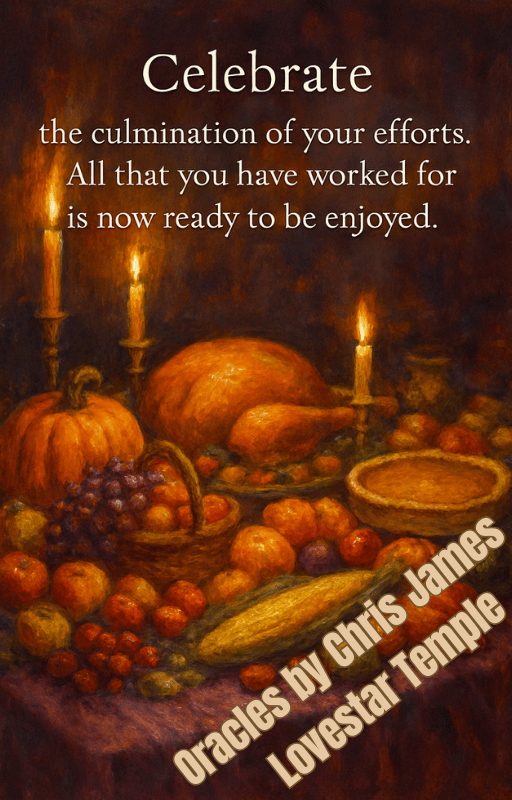
I present to you the following brand-new Thanksgiving oracle cards, I obtained 4 to promote this adorable deck by Chris James. I will be telling you more about his cards in the next month.
Goddess Message – Thanksgiving Harvest
“Beloved, the goddess gathers you close and whispers: This is your season of ripeness. What was once seed, struggle, or silent prayer has risen into form. You have tended your inner garden with devotion, and now the fruits stand before you.”
She invites you to pause. To breathe. To recognize that the abundance surrounding you is not an accident, it is a reflection of your courage, your labor, your willingness to believe when nothing had blossomed yet.
Read the rest of this message on ko-fi for free through this link and support Eve Lovestar:
Chris James is my beloved, Scorpio, who had an interest in tarot until I discovered the secret interest, now he is creating really cool decks for me. Thank you.
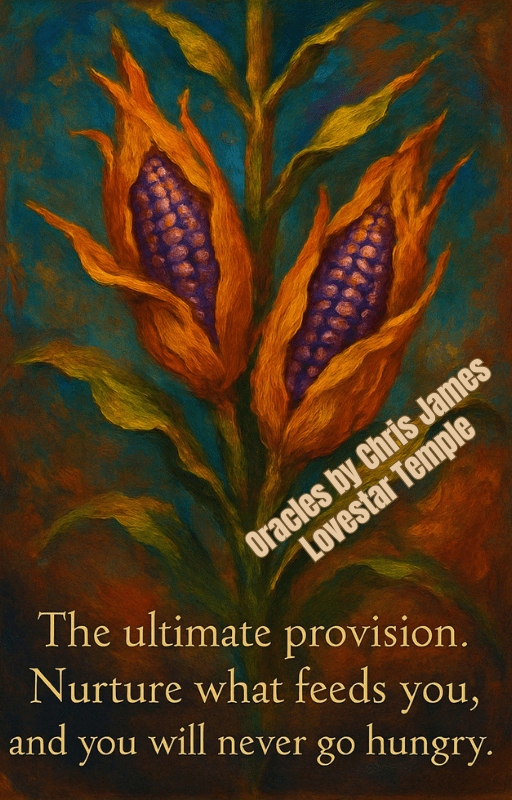
Goddess Message – “Sacred Provision”
Beloved, the Goddess of Nourishment comes to you now with a simple truth: You are sustained by what you honor.”
She shows you the sacred corn, nature’s ancient gift and reminds you that abundance is not random, nor is nourishment accidental. It is the result of devotion, reciprocity, and care.
You are being guided to notice: What truly feeds your soul? What fills you with life? What keeps your spirit warm and your path illuminated?
Read the rest of this message on ko-fi for free and support Eve
(For the Living, the Departed, and the One You’re Calling In This Thanksgiving)
In a world overflowing with fleeting texts and hurried conversations, a gratitude letter is a gift of presence. It is a moment of pause. A soulful acknowledgment of love. A devotion in ink.
As we approach Thanksgiving, a season rooted in reflection, appreciation, and communal warmth, writing a gratitude letter to your beloved can become a transformative ritual. Whether your love is beside you, in spirit beyond this world, or still on their way into your life… this letter is a sacred offering.
My tip for your letter being welcomed? Write it in their language. Let us discuss this.
Below, you’ll find structure, inspiration, and gentle instructions for creating a gratitude letter tailored to where your heart is right now.
☆☆☆
Why a Gratitude Letter?
Because love deserves language. Because feelings deserve form. Because gratitude deepens connection.
Gratitude doesn’t have to be emotional. The idea is finding the things we are truly grateful for, not being demanding or manipulating through false gratitude.
A gratitude letter:
strengthens intimacy
softens vulnerabilities
heals emotional distance
honors memory
invites future love into existence
It is prayer and poetry combined.
it creates more of what you appreciate.
☆☆☆
How to Begin
Before you write… Create a moment.
Light a candle Pour tea or wine Sit somewhere comfortable Slow your breathing
And ask yourself:
What have they given me, emotionally, spiritually, and experientially, that changed me for the better? Then feel good about what you find.
You’re ready.
☆☆☆
Structure of a Gratitude Letter
You can follow this simple flow:
1. Opening & Address Speak to them by name or with a term of endearment.
2. Acknowledgment of Presence Where are you in life, emotionally? Where are they in relation to you?
3. Thank you for… List specific things. Not generic. Specific.
4. Memory or Moment Recall a detail or shared experience.
5. The way they changed you: Describe the shift in your heart or your worldview.
6. What you wish for them Blessings, intentions, love but only mention things you know they would appreciate.
7. Closing sentiment Something personal.
☆☆☆
If Your Partner is With You Now
Write to them directly.
Focus on:
small kindnesses
humor shared
resilience
growth together
the mundane beauty
the extraordinary tenderness
Example starters:
Thank you for the way you look at me when I’m tired…
Thank you for choosing me, again and again…
I love how safe I feel with you…
Tell them what you appreciate that you rarely say.
☆☆☆
If Your Beloved Has Passed Away ☆ sorry for your loss, and may you feel their presence through your gratitude. 🙏
This is sacred ground.
Writing to a departed love is a form of grief alchemy.
You can:
thank them for the life you shared
reflect on lessons that remain alive in you
acknowledge the pain of their absence
celebrate the eternal nature of your connection
express what you never got to say
Example starters:
I miss how your laughter filled the room…
Your love made me braver…
Thank you for the years that shaped me…
I carry you in every sunrise and every quiet night…
This letter becomes: honor + remembrance + healing. This is a ritual and may assist in healing. You will cry, focus on healing. You may place this letter in your Union Altar.
☆☆☆
If You’re Writing to a Future Partner
This is manifestation work.
A gratitude letter for the partner who has not yet arrived is one of the most powerful tools for intentional love.
Write as if they already exist. As if they are already on their way.
Thank them as though they are already loving you beautifully.
Example starters:
Thank you for choosing me with your heart wide open…
Thank you for the laughter we will share…
Thank you for being the partner I prayed for…
Thank you for cherishing my soul…
This creates:
energetic alignment
emotional clarity
subconscious preparation
spiritual invitation
A love letter as spellwork.
☆☆☆
For Thanksgiving
Here are prompts you can include:
Write about…
the love you have received this year
the lessons love taught you
how love expanded you
how you have grown in giving love
what you are grateful love will bring next
Add a blessing, like: May warmth find us always. May love light the way forward. May gratitude multiply what we cherish.
☆☆☆
End With a Ritual
After you finish the letter:
fold it carefully
press it to your heart
whisper a blessing
store it in a special place or read it aloud to your partner or leave it under your pillow
Our words become altars.
☆☆☆
A gratitude letter is more than written appreciation.
It is: a mirror of the heart, a celebration of love, a bridge between worlds, past, present, and future.
May this Thanksgiving bring you warmth, memory, and beautiful expectation. May love find you wherever you are.
Thank you for reading,
If you enjoy my content, follow the blog to learn more about how I do romance, union, and about my spur practices.
Follow me on Patreon for free goddess devotion reads and my best union work text.
Who is wicked for good
the princess witch
or the green witch?
Or is it the wizard
who rules in this
land?
The emerald dust has settled, but the world of Oz is more divided than ever. Following the spectacular first part of the Wicked film adaptation, “Wicked: For Good” is poised to dive into the heart of the story we’ve been waiting for: the profound and painful divergence of two friends who started their journey side-by-side. This isn’t just a continuation; it’s the emotional core of the saga, where the choices of Elphaba and Glinda cement their legacies and forever change the fate of Oz.
Picking up after Elphaba’s dramatic flight on her broomstick, “For Good” explores the aftermath of her defiant stand. The woman labeled “The Wicked Witch of the West” is far from the villain the Ozian newspapers proclaim. Instead, we see her transform into a secret activist, a lone voice fighting from the shadows for the talking animals the Wizard continues to oppress. Her journey is one of righteous fury and isolation, a path where every “good deed” seems to go punished, leading her toward the iconic, heartbreaking soliloquy, “No Good Deed.”
Meanwhile, in the glittering halls of the Emerald City, Glinda the Good is learning that wearing a crown is heavier than it looks. Having aligned herself with the Wizard’s regime, she now embodies the very establishment her best friend is fighting against. Her public persona is all bubble dresses and benevolent smiles, but privately, she is torn apart. The film promises to delve deep into Glinda’s dilemma: the conflict between her political power and her personal loyalty, a struggle that will define what “good” truly means in a morally complex world.
Ariana Grande Poem written with my daughters Wicked for Good – Ariana Grande Ariana Grande has those cute eyes that look so dark like black holes you never quite see what’s inside. Ariana Grande has that cute hair, the long ponytail, the romantic bow that matches her intentional stare. Ariana Grande has that cute dress and clothes that slay, the beautiful patterns, it’s quite the display of femininity. Eve Sanchez (Lovestar) with daughters Lilli and lizzie ~~~ WICKED A wicked witch I’m not. A terrible thing I’ve not done. I might be odd And green, But it isn’t my fault That I had to fit in. ~~~ If I am a wicked witch or if I am a good witch depends on the moon, not on you or me. ~~~ Did you like the Wicked movie? #Arianagrande#wicked#wickedmovie#wickedforgood#evelovestar
Fueling the fire is the manipulative Madame Morrible, who masterfully spins disinformation to paint Elphaba as a public enemy. This battle for the narrative is as crucial as any magical duel, setting the stage for Elphaba’s multi-front war against the Wizard’s power and Morrible’s propaganda.
But the central heart of the story remains the fractured friendship between the two witches. “For Good” is ultimately their story, a testament to how two people who loved each other can be pulled apart by ideology and circumstance. Their evolving relationship, from inseparable friends to estranged adversaries, is the emotional engine of the film, building towards the moment they sing the poignant anthem to their complicated bond, “For Good.”
The web of consequences widens to include Nessarose and Boq. We’ll see Elphaba’s sister ascend to the governorship of Munchkinland, a position of power that twists into tragedy. Her relationship with Boq takes a dark and fateful turn, setting in motion the events that will lead to one of the story’s most pivotal moments.
WICKED
A wicked witch
I'm not.
A terrible thing
I've not done.
I might be odd
And green,
But it isn't my fault
That I had to fit in.
I'm just me.
Themes to Watch For:
The Complexity of Good and Evil: The film challenges the black-and-white fairy tale narrative, asking us who gets to decide what is “wicked” and what is “good.”
The Price of Power: Both Glinda and Elphaba pay a steep price for the power they wield, one through public conformity, the other through rebellious exile.
Friendship and Betrayal: It explores how love and betrayal are often two sides of the same coin, and how someone can change your life forever, even if they are no longer in it.
Set for release on November 26, 2025, “Wicked: For Good” promises to be a powerful and poignant conclusion, filling the skies of Oz with more than just flying monkeys, but with the enduring legacy of two women who, for better or worse, changed each other for good.
If I am a wicked witch
or if I am a good witch
depends on the moon,
not on you or me.
What is premium content on my Patreon is goddess devotion, so you can read everything I am learning about goddesses, and I did decide to create a thing about as many gods as I can, but as you know, I love the goddesses, not the gods.
The 12 Olympians: The A-List of Ancient Greece
When we hear names like Zeus, Athena, or Apollo, we often picture majestic marble statues or dramatic scenes from movies. But for the ancient Greeks, these gods were the fundamental forces that shaped their world, their culture, and their understanding of life itself. They were a complex family of immortals, each with their own domain, personality, and flaws, reflecting the full spectrum of human experience.
Today, we’re starting a journey to meet the Olympians, the divine rulers who called Mount Olympus their home.
Where Did the Gods Come From? It All Started with Chaos
Before the familiar gods of Olympus, there was only Chaos—a void of nothingness. From Chaos emerged the first primordial deities, including Gaia (Earth) and Ouranos (Sky). Their union created the Titans, the first rulers of the cosmos.
The most important Titan, Cronus, overthrew his father Ouranos. Fearing a prophecy that he too would be overthrown by his own child, Cronus swallowed each of his children at birth. His wife, Rhea, desperate to save her youngest, Zeus, tricked Cronus by giving him a stone wrapped in swaddling clothes. The infant Zeus was hidden away and raised in secret.
When he came of age, Zeus forced Cronus to disgorge his siblings: Hestia, Demeter, Hera, Hades, and Poseidon. What followed was a cataclysmic war known as the Titanomachy, where Zeus and his siblings fought the Titans for supremacy. Victorious, the three brothers drew lots to divide the world:
Zeus: King of the Gods and ruler of the Sky.
Poseidon: God of the Seas, Earthquakes, and Horses.
Hades: God of the Underworld and ruler of the Dead.
With the cosmos divided, a new era began—the age of the Olympian Gods.
The 12 Olympians: The A-List of Ancient Greece
While the number sometimes varies, the canonical Twelve Olympians were the principal deities of the Greek pantheon. They were not distant, all-powerful beings; they were passionate, jealous, generous, and vengeful.
Here is a quick introduction to the core twelve:
Zeus: The ruler of the gods, god of the sky, lightning, thunder, law, and order. His weapon is the thunderbolt.
Hera: The queen of the gods, goddess of marriage, women, and family. She was both the wife and sister of Zeus.
Poseidon: God of the sea, rivers, floods, droughts, and earthquakes. His symbol is the mighty trident.
Demeter: Goddess of the harvest, agriculture, and the sacred law of the cycle of life and death.
Athena: Goddess of wisdom, handicraft, and strategic warfare. She was born, fully armed, from Zeus’s forehead.
Apollo: God of light, the sun, prophecy, philosophy, archery, medicine, music, and poetry.
Artemis: Goddess of the hunt, the wilderness, wild animals, the moon, and chastity. Apollo’s twin sister.
Ares: God of war, specifically the violent and brutal aspects of battle.
Aphrodite: Goddess of love, beauty, pleasure, and procreation. She was born from the sea foam.
Hephaestus: The master blacksmith and craftsman of the gods, god of fire, metalworking, and sculpture.
Hermes: The messenger of the gods, god of trade, thieves, travelers, sports, and border crossings.
Dionysus: The youngest Olympian, god of wine, viticulture, fertility, ritual madness, and religious ecstasy.
(Hades, while a major god, did not reside on Mount Olympus and is typically not counted among the Twelve. Hestia, the original Olympian of the hearth, gave up her seat to Dionysus to maintain peace.)
The Greek gods are timeless because they are so profoundly human. Their myths are not just entertaining stories; they are archetypal narratives that explore love, loss, ambition, jealousy, and the struggle for power. They were used to explain natural phenomena (why the seasons change, why volcanoes erupt) and to teach moral and social lessons.
From Renaissance art to modern-day psychology (think “Oedipus Complex” or “Narcissism”), the legacy of these deities is woven into the very fabric of Western civilization.
In our next post, we’ll dive deeper into the tumultuous life of the King of the Gods himself: Zeus! We’ll explore his many loves, his powerful children, and why he was both revered and feared.
Want to Dive Deeper? Here are some excellent resources for further research:
Theoi Greek Mythology: An extensive and meticulously researched resource on the gods, spirits, and creatures of Greek mythology, complete with original texts.




 Lovestar Temple🔥 🔥