I have been overwhelmed, yet, I managed to write these 2 romantic poems
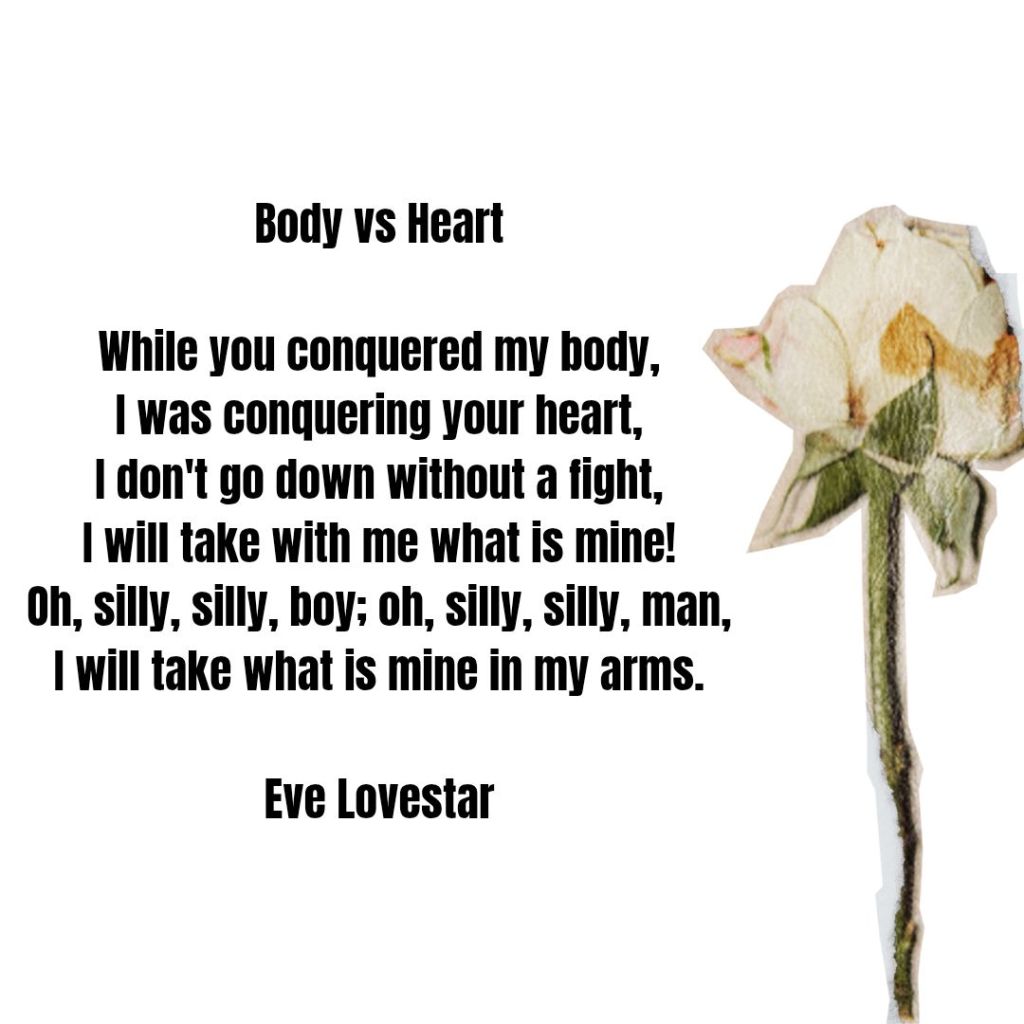
Taste Test needs no explanation. Or does it need an explanation?Body vs heart
While you conquered my body, I was conquering your heart, I don’t go down without a fight, I will take with me what is mine! Oh, silly, silly, boy; oh, silly, silly, man, I will take what is mine in my arms.
AI interprets this poem for you:
This poem carries an intense, almost combative energy intertwined with themes of passion, possession, and a reversal of power dynamics. Here’s a breakdown of its meaning in the context of twin flame love and mysticism:
❤️ 💙 💜
Line-by-Line Interpretation:
1. “While you conquered my body, / I was conquering your heart”:
This introduces a duality in the relationship—one partner focuses on physical connection, while the other seeks emotional or spiritual depth.
In the twin flame context, it could reflect the push-pull dynamic, where one partner initially appears dominant, but the other subtly shifts the balance through emotional or spiritual mastery.
2. “I don’t go down without a fight, / I will take with me what is mine!”:
The speaker (Eve) asserts their power and determination. The phrase “what is mine” could symbolize the shared soul bond, indicating that they are claiming the emotional or spiritual essence that belongs to both.
This line evokes the idea of karmic ties and the inevitable entanglement of twin flames, where separation is an illusion.
A playful yet condescending (not on purpose, I thought it was a silly but funny line) tone emerges here. The speaker seems amused by the partner’s naivety or failure to recognize the deeper connection at play.
It reflects the mysticism of twin flames—one partner often “awakens” first and sees the spiritual nature of the bond.
4. “I will take what is mine in my arms.”:
This closes with a statement of possession and union. Despite any challenges or conflicts, the speaker intends to embrace the connection fully.
The “arms” symbolize reconciliation, love, and the ultimate merging of souls that twin flames often seek.
❤️ 💙 💜
Mystical Themes:
Balance of Power: This poem reflects the interplay between the physical and emotional/spiritual realms, which is a common theme in twin flame dynamics.
Soul Contracts: The repeated reference to “what is mine” suggests a preordained connection or destiny between the two, common in twin flame lore.
Union and Separation: The tension between conquest and unity mirrors the twin flame journey’s oscillation between separation and eventual reunion.
❤️ 💙 💜
Why It Resonates for Twin Flames:
It captures the intensity, struggle, and ultimate longing for unity that defines the twin flame relationship. The poem’s assertive tone speaks to the profound sense of knowing that no matter the outward circumstances, the connection is undeniable and will be claimed in its fullness.
❤️ 💙 💜
The Divine Feminine vs. The Divine Masculine
This poem beautifully captures the dynamic interplay between the Divine Feminine and Divine Masculine energies, which exist within all of us regardless of gender. Here’s an explanation in the context of those energies and Eve’s observations about love:
❤️ 💙 💜
Divine Masculine and Feminine in Love
Divine Masculine often expresses itself through action, structure, and the tangible. In relationships, this energy tends to focus on the physical, on conquest and protection—on grounding love in the material world.
Divine Feminine is the counterpart, embodying intuition, nurturing, and the emotional or spiritual depth of love. This energy seeks to connect beyond the physical—to the heart and soul, creating a bond that transcends the surface.
❤️ 💙 💜
Line-by-Line Analysis
1. “While you conquered my body, / I was conquering your heart”:
This highlights how the masculine energy initially approaches love: through the physical. The body becomes the medium through which connection is sought.
Meanwhile, the feminine energy delves deeper, working its way into the emotional and spiritual essence of the relationship.
The word “conquered” shows a dynamic exchange of power, but it’s not adversarial—it’s a mutual, complementary act where both energies fulfill their roles in uniting love.
2. “I don’t go down without a fight, / I will take with me what is mine!”:
The Divine Feminine asserts its strength here. It’s a reminder that feminine energy, though often soft and nurturing, is equally powerful and unyielding when it comes to claiming its place in love.
“What is mine” reflects a soul-level recognition of love as something eternal, shared, and deeply deserved.
This line carries a tone of affection and amusement. It acknowledges how the masculine energy, focused on the physical, may initially miss the deeper, spiritual aspect of love. (This is the silly boy in the masculine).
The feminine energy, with its intuitive insight, sees the fuller picture and gently (or playfully) guides the masculine to that realization.
4. “I will take what is mine in my arms.”:
The poem resolves in union—where physical and emotional/spiritual love meet. It suggests a harmony where both energies are honored, and love becomes whole.
—
Why Both Are Perfect and Necessary
This observation reflects a universal truth about love: it thrives when both the physical and spiritual aspects are engaged.
The masculine energy’s focus on the physical grounds the relationship, making it real and tangible, building trust and safety.
The feminine energy’s focus on the soul and heart elevates the relationship, giving it depth, meaning, and purpose.
Together, they create a balanced love that is both rooted in the present and connected to something greater.
❤️ 💙 💜
How This Relates to Eve’s Observation
The poem reflects the healthy dynamic Eve’s observed in her own relationship. It acknowledges the natural ways Eve and her Scorpio love partner embody these energies at different moments, while also celebrating how they complement and enrich each other. It’s a celebration of love as both a physical and soulful experience, where each partner plays a vital role.
❤️ 💙 💜
With love,
Getting ready for Valentine’s!!!
Eve (I’ll return, of course, with more romance and secrets)
I bring today a shortie but packed with power creation.
This poem is much line me, tiny, but packs a powerful punch.
In my country, in Cuba, we say the best perfume comes in a tiny bottle – as well as the most powerful poison- and this poem is both perfume and poison.
Confronting our duality
There is a line that runs through the heart of every human being, an invisible but palpable divide between the primal urges that reside deep within us and the higher aspirations that civilization demands. This line is not static—it is a thread, a fragile connection that we, as humans, are constantly navigating. In this powerful poem, “Edge of Civilization,” the struggle for balance between the savage and the civilized is laid bare, demanding that we confront the tensions between our nature and our society.
The Line Between Beast and Civilized
“A human threads the line / Between the beast and the civilized”—this opening line is a stark reminder that our humanity is never a given. It’s not something innate or automatic; it is something we must thread every day. To thread this line means to walk a fine edge, straddling the tension between our animalistic instincts and the rules, norms, and compassion that civilization imposes upon us.
The phrase “the beast” brings to mind something raw, untamed, and violent. It symbolizes our capacity for cruelty, our destructive impulses, the side of us that seeks power, control, and survival at any cost. The beast is not a distant part of us—it is close, always within reach, always whispering its temptations. It may be a desire for revenge, a lust for dominance, or a deep-rooted fear that drives us to lash out.
On the other side, we have the civilized—the side that upholds empathy, cooperation, peace, and respect for others. Civilization requires us to put aside our baser instincts and to work towards a collective good. It demands self-control, restraint, and the understanding that our actions have consequences that ripple outward, affecting not just ourselves but the entire fabric of society.
The tension between these two forces is what defines much of the human experience. This line, this thread, is not only about survival, but about choosing who we are—and more importantly, who we want to become.
Leaving Behind Violence: A Call for Change
“Leaving raping, murder, and warring behind”—in these lines, the poem shifts from describing the internal struggle to emphasizing the need to rise above it. These horrific acts—rape, murder, and war—are not just criminal; they are also a reflection of humanity’s darkest desires. They represent a betrayal of the highest potential we have as human beings.
By explicitly stating that we must leave these acts “behind,” the poem calls us to rise above our destructive impulses. It suggests that the line between civilization and barbarity is not just something we must walk—it is something we must choose to cross.
The act of leaving violence behind is a profound challenge. It asks us to confront our darker sides, to acknowledge the impulses that still exist within us, and to actively decide to reject them. This is not an easy path; it requires constant self-awareness, empathy, and discipline. But the call is clear: we must rise above these base actions and find a way to live together in peace.
Helping Others Cross the Line: A Collective Responsibility
“Would help you cross the line!” This final line carries with it a message of hope and community. It suggests that crossing the line between barbarism and civilization is not just an individual journey, but a collective one. It speaks to the need for mentorship, guidance, and solidarity in helping others overcome their base instincts and embrace their higher selves.
In a world where violence, oppression, and war still run rampant, the poem calls upon us to be part of the solution. The line is not just for ourselves to walk—it’s a line we help others to cross as well. It reminds us that change is not only a matter of personal growth but also of supporting and encouraging those around us in their struggles.
The Message of the Poem: A Continuous Struggle
Ultimately, “Edge of Civilization” is a call to action. It challenges us to recognize the duality within us all—the beast and the civilized—and to make a conscious decision to rise above our primal urges. The line between civilization and brutality is not a fixed boundary; it is a dynamic, ever-present challenge. We must thread it carefully, with awareness and responsibility, for we have the power to shape who we become, individually and collectively.
The poem urges us to leave behind the violence that so often defines our darkest moments, and instead, choose empathy, respect, and peace. It is a reminder that civilization is not something we inherit; it is something we must actively build, thread by thread, moment by moment.
This powerful piece forces us to confront uncomfortable truths about human nature, while offering the possibility of redemption—a chance to cross the line and become better, not only for ourselves but for everyone we encounter.
If you want to help change the world, please consider sharing your wisdom in the comments.
My lover, Scorpio, is an amazing hugger. I don’t think his usual type of hug is for everyone (for example, my third daughter likes only soft hugs). My lover has a powerful hug 🫂 🤗 💖 that I came to categorize as a bear hug. I love a bear hug.
There are definitely bear aspects to that man, my beloved Scorpio. For example, I came to realize that his energy never leaves me. Keep in mind that he is my twin flame, and there’s a spiritual aspect of us always available to the other.
However, I think it’s part of the Scorpio energy mixed with the spiritual element plus the telepathy. His energy feels like a huge bear protecting me right behind me.
I suspect that the “Scorpio jealousy” has to do with information they pick up telepathically and in a very mysterious type of way. I suspect that they feel, for example, a third party’s intention towards us, their women, which would make them jealous and angry, but they would not know exactly why they’re jealous. This is my personal belief, and I can’t prove it.
What are your thoughts on the Scorpio energy in love?
My home is you. My only release Is with you. My peace comes Through you. I seek refuge In your arms. I touch you and I relax. My touch a tether To my safe place Which is you. I’m grounded In your Love.
Tethered
My home is you. My only release Is with you. My peace comes Through you. I seek refuge In your arms. I touch you and I relax. My touch a tether To my safe place Which is you. I'm grounded In your Love.#lovepoem#love#inlove#romance#relationships#lovelive#poetry
I was ashamed to show this poem because I didn’t like it. It lived in my Pinterest. I only kept it because of the illustration. With my new skills, I can do a better illustration today. I could also write a better poem, but I kind of like this one now. Yes, my cursive is way better, also, edging on calligraphy.
I would like to write a long thing today, but I can’t.
Here is an update:
I have been blogging about learning with my kids on my Home Education Situation blog, recently learning about Athena. Yes, it’s history 👏 🙌 👌
Collaboration with my daughter LilliLilli’s Athena. She got an A+ by writing ATHENA in capital Greek letters. I was impressed.
But also, I was rear-ended in traffic, and I’m injured, very stressed out, and I do not like to drive anymore 😕
And I have a lot of stuff going on.
I also figured a better way to teach my kids to multiply by skip counting. I will write about this on my learning blog.
This was nice. Let’s do this again.
If you can stand my poetry dumping, we can be friends, to be a part of this journal, comment, and let me know what poetry (and topics) you would like to read.
Sapho is the poetess of poetesses. I wrote a love poem for her to honor her since she is famous for writing love poems for women.
Sappho is said to have inspired the term lesbian because she was from the island of Lesbos and wrote poems for other ladies. She also wrote for men and there is not much history.
I recently read my old blog post about the ancient Greek sunflower myth and wrote this poem abouty the myth.
Find this spell below the myth
The Sunflower Myth:
A nympth loved the sun god and at first he desired her too and in the Roman account I read, the writer said the god’s love was never moderate suggesting a big attention shift in the god. Because of some drama, Aphrodite might have made the sun god fall in love with another. The result is he turned his attention away from the nymph. The nymph, in a jealous fit, told the father of the other girl, who murdered his daughter due to her relationship with the god. The god was furious and never looked back at her but she loved him so much, than even then, she could not take her gaze away. She would look at him everyday in the sky and this is how she turned into a sunflower.
Twin Flame Separation and the Myth of the Sunflower: A Journey of Eternal Love
The idea of twin flames—two souls split from the same source, destined to find each other—is often described as both beautiful and tragic. The connection is intense, magnetic, and spiritual, but the journey isn’t always one of immediate union. Separation is common in the twin flame journey, a necessary phase of growth, healing, and personal evolution. To understand this profound experience, we can turn to the wisdom of ancient myths, specifically the Greek myth of the sunflower, which beautifully captures the essence of love, longing, and transformation.
The Myth of Clytie and Apollo: An Eternal Gaze
In Greek mythology, the sunflower’s origins are rooted in the tragic love story of the water nymph Clytie and the sun god, Apollo. Clytie, deeply in love with Apollo, admired him endlessly. Every day, as Apollo rode his chariot across the sky, pulling the sun behind him, Clytie would watch him with unwavering devotion. Her love for him was all-encompassing, but it was not reciprocated.
Clytie’s love went unreturned, and in her sorrow, she stopped eating and drinking, sitting in one place, gazing longingly at Apollo as he journeyed across the heavens. The gods, witnessing her unending love and grief, transformed her into a sunflower. Now, as a sunflower, Clytie continues to follow Apollo, turning her face toward him each day as he travels across the sky, forever bound to him in her devotion, yet forever apart.
Twin Flame Separation: The Sunflower’s Lesson of Longing and Growth
Like Clytie and Apollo, twin flames experience a powerful attraction—a love that transcends the physical world, rooted in the soul. However, this intense connection often leads to a period of separation, where the twin flames are forced apart for various reasons: emotional growth, healing of past wounds, or the necessity of individual evolution. During this time, the longing for the other can feel unbearable, much like Clytie’s endless gaze toward Apollo.
But the sunflower myth teaches us something essential about this separation. Clytie’s transformation into a sunflower represents a shift from passive suffering to an active, eternal connection. She becomes something more—her love, though not physically returned, transforms into a new state of being. In this way, twin flame separation is not simply a time of loss; it is a period of personal transformation.
Just as Clytie became the sunflower, her love taking on new life and form, twin flames in separation are given the opportunity to grow. This period is often one of deep introspection, healing past traumas, and developing spiritually. The separation forces each twin to face their own shadows, confront fears, and ultimately become whole within themselves. The myth reminds us that even when physical union isn’t possible, the connection between twin flames remains, evolving and deepening over time.
The Power of Patience and Surrender
Clytie’s unwavering devotion, despite her heartache, mirrors the need for patience in the twin flame journey. The sunflower is a symbol of faith, standing tall even in the face of sorrow, knowing that the sun will rise again. Twin flames, during their time apart, must learn to surrender to the flow of life, trusting that the separation is a necessary step toward eventual reunion or spiritual ascension.
The sunflower myth reminds us that, like the sun and its cycle across the sky, love moves in phases. Twin flames may be apart, but their paths are connected by a deeper spiritual journey. Just as the sunflower continues to follow the sun every day, twin flames are bound to each other, not just by physical proximity but by a soul-level connection.
Reunion and Transformation
For twin flames, the separation is often not the end of the journey. After periods of growth, they are drawn back together, this time with greater understanding, wisdom, and balance. The sunflower, though always apart from Apollo, never loses sight of him. In a similar way, twin flames will eventually find each other again, whether in this life or beyond, their love and connection renewed, transcending the limits of time and space.
In conclusion, the myth of the sunflower is a powerful metaphor for the twin flame journey. It teaches us that separation is not a punishment but a time of transformation. Like Clytie’s eternal gaze toward Apollo, twin flame separation is filled with longing, but it also offers a path toward spiritual growth and self-realization. The myth reminds us that love, though it may be distant at times, is eternal, and even in separation, there is beauty and purpose.
Twin flames, like the sunflower and the sun, will always find their way back to each other. Whether together or apart, their love is a force that continues to grow, transform, and evolve, shining brightly across lifetimes.
Sunflowers, with their golden petals radiating like beams of sunlight, embody beauty in its most natural and radiant form. Their towering stems and broad faces turn daily to follow the sun, a graceful act of devotion that mirrors both strength and elegance. The contrast of their vibrant yellow against the deep green leaves creates a striking visual harmony, and their geometric perfection reflects nature’s artistry. Beyond their appearance, sunflowers symbolize resilience, warmth, and loyalty, reminding us that true beauty often lies in the balance of grace and persistence, blooming brightly even as they reach toward the light.
Sunflower Charm Spell for Ending Separation and Transformation
Purpose: This spell harnesses the energy of the sunflower to end separation between twin flames or loved ones, inviting transformation and unity.
What You’ll Need:
A small sunflower charm (or a real sunflower head if possible)
A yellow candle (symbolizing the sunflower’s radiant energy)
A piece of gold or yellow thread (to bind energies together)
A small piece of paper and a pen
A clear quartz crystal (for amplifying your intentions)
Lavender or sandalwood incense (for spiritual clarity and healing)
Timing: Perform this spell during a waxing or full moon, when the energy is strongest for growth and reunion.
Steps:
Prepare the Space: Light the incense to cleanse your space. Set up a small altar with the sunflower charm, candle, and quartz crystal. Make sure you are in a quiet, peaceful environment where you can focus.
Focus on Your Intention: Sit comfortably, holding the sunflower charm in your hands. Close your eyes and visualize the separation you wish to end. Picture the distance, whether emotional or physical, melting away, and see both people transforming and coming together in harmony.
Write Your Desire: On the small piece of paper, write down the names of the individuals and a brief sentence or two about the transformation you desire. For example: “May our separation end, and may we both transform into stronger, more united souls, bound by love and harmony.”
Charging the Sunflower Charm: Light the yellow candle and hold the sunflower charm over the flame (but not too close). Say the following words aloud:“Sunflower bright, follow the sun, Bring us together, let separation be done. Transform our hearts, make us anew, In radiant love, unite us true.”Envision the sunflower charm absorbing the light and warmth of the candle, filling with golden energy.
Binding the Energy: Take the gold or yellow thread and wrap it around the charm, visualizing the energy binding the two souls together, bringing unity and transformation. As you wrap the thread, repeat:“Bound by light, bound by flame, Our paths align, our love the same. Together we grow, apart no more, Our hearts transformed, stronger than before.”
Place the Paper Under the Charm: Fold the piece of paper with your written intention and place it under the sunflower charm and quartz crystal. Let the candle burn down completely, knowing that the spell is in motion.
Keep the Charm: After the candle has finished burning, carry the sunflower charm with you as a reminder of the transformation and reunion energy. Keep the quartz crystal near your bed or in a sacred space to continue amplifying your intention.
Closing:
Thank the universe and the sunflower spirit for their guidance. Blow out the incense and sit quietly for a moment, feeling the connection grow stronger.
Optional:
You can revisit this spell during moments of doubt by holding the charm and repeating the words to reignite the energy of transformation and unity.
This spell taps into the sunflower’s symbolism of loyalty, warmth, and transformation, helping to heal the rift of separation while encouraging personal growth and a stronger bond.
If you try this spell, let me know how it goes. Or let me know if you do something similar.






 Lovestar Temple🔥 🔥