Category: Italiano

  • The Sea, Venus, and Italian poetry

    Dear Lovestar,

    I wrote a poem half in Italian

    Italian is a very poetic language and I am learning some Italian, simply for fun. Writing poetry in Italian is easier than in Latin for me because Latin, being a dead language is much more difficult thatn Italian, even though I have barely studied Italian.

    I am learning Italian because I think it would help me in my Latin learning journey, and also because I thought it would be easy, then I find the beautiful Italian poetry and figure it was meant to be!

    Some themes I noticed in Italian art and music. I speak soon, but Italian music (I have been listening and singing for my learning and I will talk of it again) talks a lot about the heart (il cuore), Spanish also. In fact in Spanish, we call a beloved person mi corazon (my heart).

    Italian music also mentions this word a parola which means word. It is mentioned so much that I learned the word from music and looked it up, then learned the meaning. O have to learn more but it appears that it is used as one’s word, a word, the feelings in words, the meaning, things like that. By comparison, we do not use the word “word” in English as much in poetry.

    Anf the third theme I noticed was the sea. It makes sense since Italy is surrounded by sea basically. It appears that Italians love the sea and they inmortalie it in their art. In a beautiful song I heard a man singing he was going to the sea and to find a mermaid (Sono una sirena = I am a mermaid)

    It is not pure luck that all these things are related. It is all meant to be. Example, Venus, the Roman was ancient Italian, basically, see why she was born at sea? Well, of course, because she was born in Greece, an island as Aphrodite. Venus (the Roman Aphrodite) was seen as the mother of Rome (the now capital of Italy).

    In my poetry, I did not inlcude parola because I need to understand the word more.

    English translation:

    My heart lives in the sea
    Its vastness, like my love,
    Its calm, its color,
    Its profundity, my soul.

    Italian poetry. Dante and his divine comedy

    Did you know that the popular Italian poet Dante Alighieri was exiled? I need to know more about this man’s history.

    Dante Alighieri’s “Divine Comedy,” written in the early 14th century, is a seminal work in Italian literature and a cornerstone of Western cultural heritage. This epic poem, composed of three parts—Inferno, Purgatorio, and Paradiso—traces the journey of the soul through Hell, Purgatory, and Heaven.

    Dante’s choice to write in vernacular Italian rather than Latin was revolutionary, elevating the Tuscan dialect to a prominent literary language and setting a precedent for modern Italian. His work not only advanced Italian literary tradition but also profoundly influenced subsequent writers and thinkers, solidifying his role as a pivotal figure in the evolution of Italian language and literature. I learned this from Podcast Italiano on Youtube.

    Dante was exiled from Florence in 1302 due to political conflicts. He had been involved in the complex political and factional struggles of Florence, which led to his banishment. The “Divine Comedy” was written during his exile and is often seen as a reflection of his personal and political grievances, as well as his broader philosophical and theological concerns. The work itself did not cause his exile, but it did encapsulate his views on justice, politics, and morality, which were influenced by his experiences of exile.

    But was he exiled because of his poetry? Was he using poetry to attack his political enemies?

    The fault is of politics, obviously! Yet, poets will poet. And yes, I used poet as a verb.

    Learning some Italian,

    Eve

  • New Poetry, arts, and crafts: Ancient stream, mermaid necklaces, Spanish lesson, and more

    Dear Lovestar,

    It was an intense time. This past Lion’s Gate season was very creative for me. I loved every minute of it, and the message I received from “the universe” was to create, write, and share. Luckily for me, it  came with a lot of inspiration.

    The Ancient Stream: more on this ancient inspiration soon.

    The Pythia: high priestess of Delphi
    Laurel heart: Greek inspired art
    Aphrodite’s dress (in progress work of art)
    Aphrodite in Ancient Greek
    Cleopatra by my artist daughter, Lilli because in our home education situation we talk so much about history.
    Edit

    Rima y Ritmo: Spanish lesson. Learn free on my home education blog or purchase the complete ebook on Etsy

    Eve Sanchez is my name. I write as Eve Lovestar about spiruality, magic, and twin flames.

    For the free Lesson, follow my home education situation blog:

    Free Spanish Lesson. Class 1, greeting for beginners. In depth, uses poetry, by a native poet. Follow for future lessons
    Rima (rhyme) y (and) Ritmo (rythm)

    Purchase the Rime and Rythm class 1 on Etsy: includes a lesson plan, printable worksheets, a test, and more

    https://evelovestar.etsy.com/listing/1780462505

    Home Education

    I am trying new things for my kids education and one cool thing we’ve been doing for less than a month is taking our 3 big girls to jiu-jitsu class. While there, our oldest reads and the two little ones draw amongst other things.

    Knot Magick/ magic/ magia

    Written for my know magic ebook. Which I created to collect all my research on the topic, to share mantras, and tips for modern knot magic. Purchase this ebook for only $1.11 on my Etsy shop

    https://evelovestar.etsy.com/listing/1762972408

    I always use “style” magic for potent astrological times. For example, I made a lovely yellow dress for the summer solstice once, and I infuse my lingerie with love/ union magic. I practice infusing energy into jewels and clothing. This year I was gently pushed to take it up a notch.

    Mermaid tie chocker. Tied to a knot magic mantra

    My Italian Practice

    My heart lives in the sea,
    Its vastness, like my love,
    Its calm, its color,
    Its depth like my soul.

    I’m learning Italian for fun:

    • Currently taking an Italian Duolingo course
    • Listening to Italian music
    • Listening to podcasts in Italian
    • Interacting in Italian on X with Italian content
    • Doing Italian karaoke
    • Learning about the Italian language and culture

    Thanks for your visit,

    With love a light,

    Eve

  • “Frantic.” My poems translated to Italian. English, Spanish, and Italian translations

    Dear Lovestar,

    I have been having fun on Twitter (X) sharing my poetry and wisdom. I shared this long poem in increments:

    “The Eternal Flame Romantic”

    I wrote this rather large poem yesterday and shared the stanzas on Twitter. Today, I’ll speak about this portion (I’ll call this stanza “Frantic”):

    I know that you’re not romantic
    Not expressive, but there’s magic
    In your touch. I am frantic.
    And I am yours if you want me.

    I followed a few poets and writers to curate my X feed. I followed back an Italian poetry lover who might also be a poet. I just followed the guy, and there’s a language barrier, so I’m not certain.

    He shared one of the short poems I shared on his feed with an Italian comment. I love languages, and since Spanish is my first language, I understood some of the words because I already knew that Spanish and Italian share similar words. I have listened to Italian musicians since childhood, many sing in Spanish as well.

    I took advantage of the situation and used AI to translate the poem to Italian because I don’t speak Italian, and AI does a great job of translation, unlike Google Translate. I then shared the poem with him and asked him in Italian to proofread it.

    This experience went well. The man said the translation was good, but he wanted to make an edit, and he polished the translation. His result was this:

    Italian Poem Translated by AI, edited by @ser-Chaw on twitter/ X

    đź’•đź’•đź’•
    So che non sei romantico
    Per nulla espressivo,
    Ma c’è magia
    Nella tua carezza.
    Mi sento frenetica

    E sarò tua se mi vuoi

    The Italian poet’s edit translated to English:

    đź’•đź’•đź’•
    “I know you’re not romantic,
    Not expressive at all,
    But there’s magic
    In your caress.
    I feel frantic
    And I’ll be yours if you want me.”

    It seems that he changed your touch for “your caress.” And I am yours if you want me for “I’ll be yours if you want me.” Additionally, he added “at all” after expressive. Same but in different words. I believe he edited it for rhyme and rhythm in Italian.

    Translated into Spanish:

    đź’•đź’•đź’•
    “SĂ© que no eres romántico
    Para nada expresivo,
    Pero hay magia
    En tu caricia.
    Me siento frenética
    Y serĂ© tuya si me quieres.”

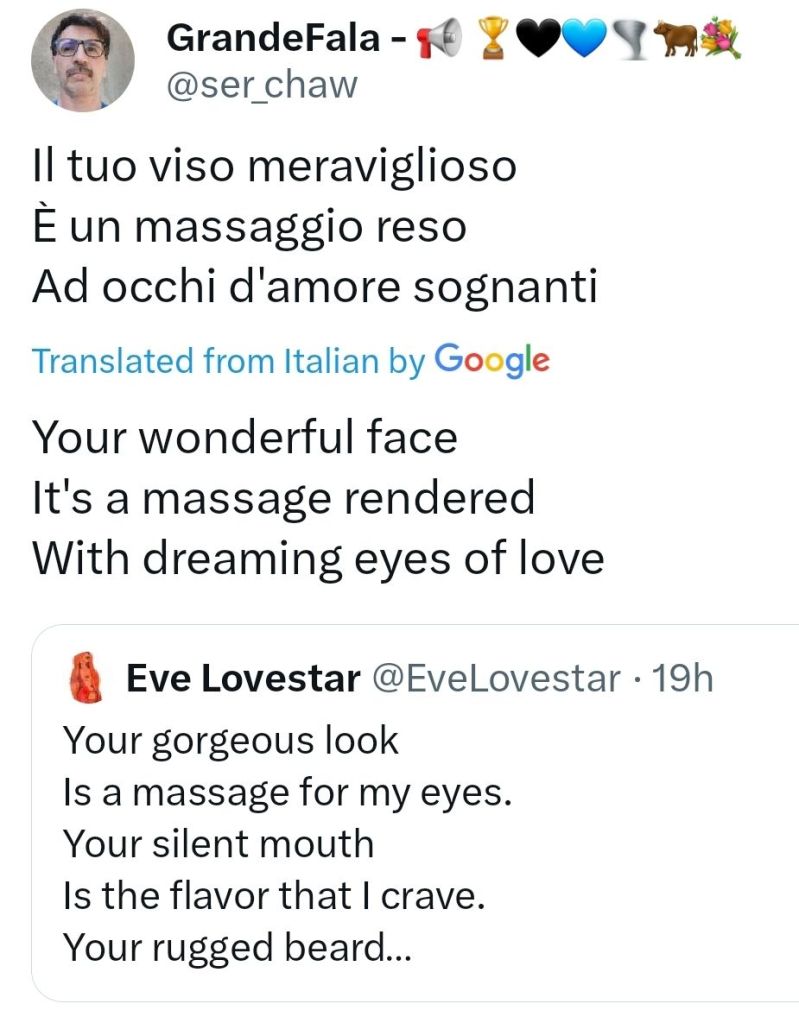
    Afterward, I noticed the Italian poet translated this other poem and more:

    Eve poem translated to Italian on Twitter

    Isn’t Twitter great?

    I immediately followed some hindi poets!

    With love,

    Eve